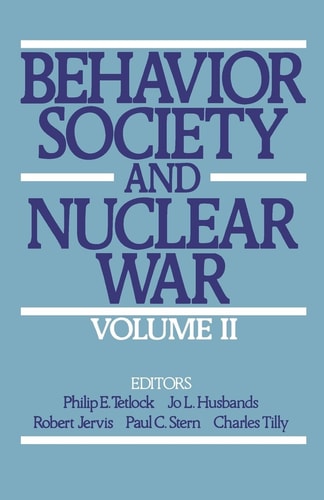
Behavior, Society, and Nuclear War: Volume II
0
0
As an Amazon Associate and affiliate partner, Menrva Books earns from qualifying purchases. Learn more
Author Description
In the last year the world has witnessed changes in East-West relations that would have been unthinkable only a short time ago. The Berlin Wall has crumbled, Eastern Europe has thrown out its authoritarian leaders, and the Soviet Union itself has undergone dramatic changes in political structure and foreign policy. The U.S. public no longer regards the Eastern Bloc as the principal threat to national security. Yet even with the undeniable thaw in the Cold War many of the old scenarios for "World War III" remain as plausible as they were in the past, and new sources of instability could arise from ethnic conflicts, economic competition, or other sources. The second volume of Behavior, Society, and Nuclear War addresses the potential causes of nuclear war within the context of this changing political landscape. As in the first volume of this series, leading scholars review specific behavioral and social phenomena and processes that may be critical in determining war and peace--how foreign policy decision are made, the role of arms races, and the activities of third-party moderators. Volume Two also explores the effects of changing international conditions on the potential for the growing importance of conflicts between small powers, the possibility that techniques of reassurance can supplement deterrence, and the sources of moderation in Soviet security policy. Informed by the most up-to-date scholarship, Behavior, Society, and Nuclear War will be essential reading for anyone interested in international relations, disarmament, political science, and sociology.
Menrva's Summary
THE THESIS
This volume investigates the persistent risks of nuclear conflict and international instability in a rapidly shifting geopolitical landscape. The authors, a distinguished group of scholars including Charles Tilly and Robert J. Jervis, utilize behavioral and social science frameworks to analyze the mechanisms of foreign policy decision-making. By examining the transition from Cold War bipolarity to a more complex global environment, the text argues that social and psychological factors remain critical variables in the maintenance of peace or the escalation of war.
THE SCOPE MAP
What You Will Find
- Analysis of behavioral processes in foreign policy decision-making.
- Examination of the role of arms races and third-party mediation in international security.
- Evaluation of reassurance techniques as a supplement to traditional deterrence strategies.
- Investigation into the sources of moderation within Soviet security policy and the rise of conflicts between smaller powers.
THE AUTHORITY PERSPECTIVE
Experts recognize this work as a significant contribution to the intersection of behavioral science and international security studies. Readers frequently note the academic density of the prose, which serves as a foundational text for students and practitioners of political science.
Page Count:
384
Publication Date:
1990-12-13
Publisher:
Oxford University Press
ISBN-10:
0195057686
ISBN-13:
9780195057683
Sociology
Nuclear Strategy
International relations
Community Tags
Other Editions(2)
Similar Books













Reader Comments
Share Your Thoughts
No comments yet. Be the first to share your thoughts!