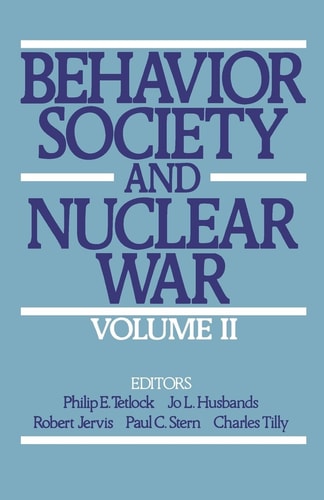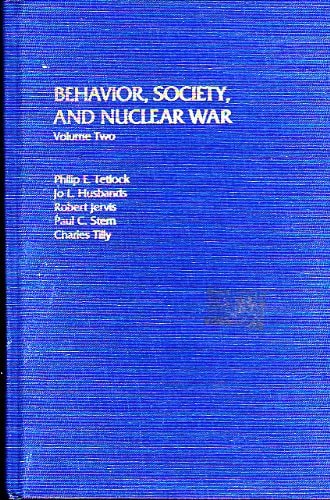
Behavior, Society, and Nuclear War: Volume II
0
0
As an Amazon Associate and affiliate partner, Menrva Books earns from qualifying purchases. Learn more
Author Description
There is a broad global consensus on the imperative to avoid nuclear war, but that consensus provides little guidance for policy. A primary reason is the lack of understanding regarding how a nuclear war might occur or how one could be prevented. This volume is part of a series that aims to examine the contributions made by the social and behavioural sciences to an understanding of the factors that may promote or inhibit nuclear war. It builds a basis for new intellectual approaches to the subject of international security. Under the sponsorship of the Committee on Contributions of Behavioral and Social Sciences to the Prevention of Nuclear War, leading scholars here review knowledge about specific behavioural and social phenomena that may be critical in determining war and peace. Among these are the behaviour of decision-makers, the pressure of public opinion, the effect of threats aimed at deterring dangerous behaviour, changes in the economic interdependence of states and the processes of negotiation when stakes are high. The book seeks to increase knowledge, to identify research directions that hold promise for yielding policy-relevant insights and to clarify convergences and disparities between these lines of research. It is hoped that a critical distillation of such knowledge can offer a basis for developing clearer knowledge and, consequently, better advice for preventing nuclear war.
Menrva's Summary
THE THESIS
This volume investigates how the social and behavioral sciences can provide actionable insights into the prevention of nuclear war and the maintenance of international security. The authors, a collective of distinguished scholars operating under the Committee on Contributions of Behavioral and Social Sciences to the Prevention of Nuclear War, synthesize existing research to bridge the gap between academic theory and policy application. By examining the psychological, social, and economic variables that influence state behavior, the text establishes a framework for understanding the mechanisms that either escalate or mitigate nuclear conflict.
THE SCOPE MAP
What You Will Find
- Analysis of decision-maker psychology and cognitive biases in high-stakes environments.
- Examination of public opinion dynamics and their influence on national security policy.
- Evaluation of deterrence theory and the effectiveness of threats in international relations.
- Assessment of economic interdependence and negotiation processes between states.
THE AUTHORITY PERSPECTIVE
Experts recognize this volume as a significant interdisciplinary effort to apply social science rigor to the existential problem of nuclear conflict. Readers frequently note the academic density of the prose, which serves as a foundational reference for students and practitioners of international security policy.
Page Count:
384
Publication Date:
1990-01-01
Publisher:
Oxford University Press
ISBN-10:
0195057678
ISBN-13:
9780195057676
History
Sociology
Social Science
Nuclear Strategy
International relations