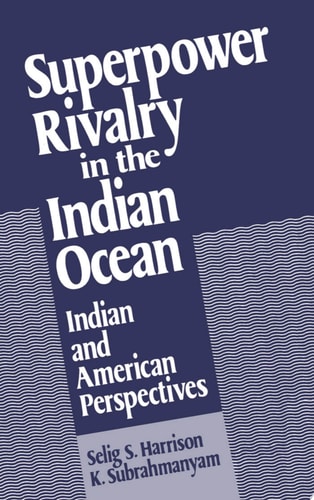
Superpower Rivalry in the Indian Ocean: Indian and American Perspectives
0
0
As an Amazon Associate and affiliate partner, Menrva Books earns from qualifying purchases. Learn more
Author Description
The vast, politically turbulent region encompassing the Indian Ocean, the Persian Gulf, forty-two littoral states, and one third of the world's population is one of the most potentially explosive theaters of superpower rivalry. In this study, three American and three Indian authors, reflecting different perspectives and areas of expertise, examine the principal factors that have led to the escalation of superpower tensions in the region: the war in Afghanistan, and its spillover into the Afghanistan-Pakistani borderlands; the Indo-Pakistani nuclear arms race; ethnic tensions in Sri Lanka; the Iran-Iraq war; Islamic fundamentalism; and the rapidly growing military presence of the superpowers in the area. Considering how India's emergence as a military power is influencing superpower and indigenous tensions in the region, the contributors compare Indian, American, and Soviet interests, and offer solutions for current Indian-American disagreements.
Menrva's Summary
THE THESIS
This study investigates the primary drivers of superpower rivalry and regional instability within the Indian Ocean theater during a period of heightened geopolitical tension. The authors, a collaborative group of American and Indian experts, analyze the intersection of local conflicts and global power interests. By examining the military and political dynamics of the region, the text provides a comparative framework for understanding how Indian, American, and Soviet objectives influence the stability of the Indian Ocean and its surrounding littoral states.
THE SCOPE MAP
What You Will Find
- Analysis of the war in Afghanistan and its impact on the Afghanistan-Pakistani borderlands
- Examination of the Indo-Pakistani nuclear arms race and its regional security implications
- Investigation into the role of ethnic tensions in Sri Lanka and the Iran-Iraq war
- Assessment of the influence of Islamic fundamentalism on regional power structures
- Comparative study of Indian, American, and Soviet strategic interests
THE AUTHORITY PERSPECTIVE
Experts identify this work as a significant contribution to the study of Cold War-era regional geopolitics. Readers frequently note the depth of the comparative analysis provided by the diverse panel of contributors.
Page Count:
320
Publication Date:
1989-05-04
Publisher:
Oxford University Press
ISBN-10:
0195054970
ISBN-13:
9780195054972
History
Indian Ocean
Military Strategy
Geopolitics
International relations
Community Tags
Similar Books