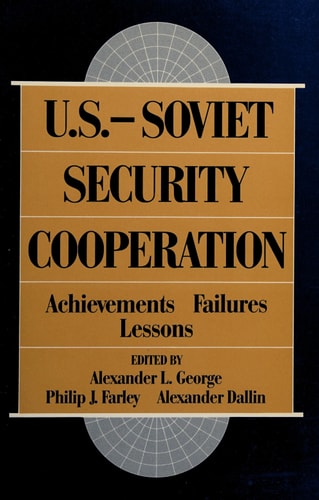
U.S.-Soviet Security Cooperation: Achievements, Failures, Lessons
0
0
As an Amazon Associate and affiliate partner, Menrva Books earns from qualifying purchases. Learn more
Author Description
The first comprehensive and systematic analysis of American and Soviet security cooperation since World War II, this volume expertly examines the pursuit of arms control, the search for stability, and the balance of power between the two countries. The twenty-one case studies, each commissioned from a highly qualified specialist on the subject in question, probe a wide range of global, regional, and bilateral situations and issues, including both successful and unsuccessful instances of cooperation. Developing a rigorous theoretical framework for analyzing and comparing these diverse cases, the contributors cast new light on the history of superpower relations.
Menrva's Summary
THE THESIS
This volume investigates the conditions under which the United States and the Soviet Union successfully achieved security cooperation during the Cold War era. The authors, including Alexander Dallin and Alexander L. George, utilize a structured comparative methodology to evaluate twenty-one distinct case studies. By examining both successful and failed diplomatic initiatives, the text establishes a theoretical framework for understanding the complexities of superpower stability and arms control negotiations.
THE SCOPE MAP
What You Will Find
- Comprehensive analysis of U.S.-Soviet security relations from 1945 through the late Cold War period.
- A rigorous theoretical framework for evaluating diplomatic cooperation and conflict resolution.
- Twenty-one detailed case studies covering global, regional, and bilateral security issues.
- Examination of arms control agreements, crisis management, and the pursuit of strategic stability.
THE AUTHORITY PERSPECTIVE
Experts recognize this volume as a foundational text for understanding the mechanics of Cold War diplomacy and superpower interaction. Readers frequently note the academic density of the prose and the systematic approach applied to historical case studies.
Page Count:
768
Publication Date:
1988-04-07
Publisher:
Oxford University Press
ISBN-10:
0195053982
ISBN-13:
9780195053982
History
International relations
Cold War
United States
Military History
Community Tags
Similar Books