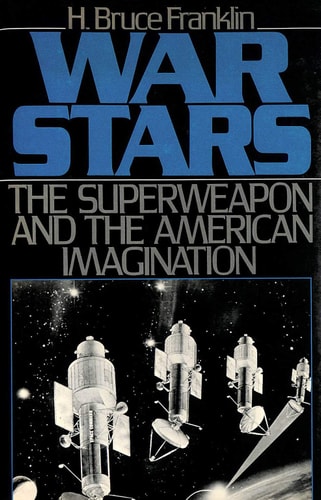
War Stars: The Superweapon and the American Imagination
0
0
As an Amazon Associate and affiliate partner, Menrva Books earns from qualifying purchases. Learn more
Author Description
Shortly after H.G. Wells published War of the Worlds, in which Martians decimate humanity, an American author countered with a buoyantly optimistic sequel, Edison's Conquest of Mars--the great Thomas Edison invents a disintegrator beam which exterminates the aliens and unifies Earth behind America. This may seem a harmless fantasy, but as H. Bruce Franklin points out in War Stars, an eye-opening analysis of the superweapon in American culture, Edison's Conquest epitomizes a pattern of thought that has beguiled Americans since the 18th century: the belief that miraculous new weapons will somehow end war and bring global triumph to American ideals. Franklin begins his analysis with Robert Fulton, who first articulated this belief by claiming that an Age of Reason--including an end to ignorance, monarchy, and war--would be ushered in by his three purely "defensive" military inventions: the submarine, the torpedo, and the steam warship. Franklin then traces this treacherously seductive idea as it weaves through American culture in many forms: the flood of "future-war" novels appearing between 1880 and World War I, in which made-in-America superweapons (including the first nuclear arms) keep the world eternally safe for democracy; Billy Mitchell's use of newsreel and popular magazines to promote air power as a weapon for peace; the animated Disney feature "Victory Through Air Power," which concludes with Japan in ruins while "America the Beautiful" plays in the background; a 1940 novel in which America uses atomic bombs to win World War II and establish a Pax Americana along the lines of the 1946 Baruch Plan; and such material products as the intercontinental bomber and missile, the atomic and hydrogen bomb, and "defensive" space weapons guaranteed to make previous superweapons "impotent and obsolete." Franklin explores over two hundred movies, rediscovering obscure works that directly influenced later decision-making and reinterpreting such modern classics as Catch 22.
Menrva's Summary
THE THESIS
This book investigates the persistent American cultural belief that the development of miraculous superweapons will inevitably end war and secure global dominance for American ideals. H. Bruce Franklin, a scholar of American culture and literature, utilizes a vast array of historical documents, popular fiction, and media to trace this ideology from the 18th century to the nuclear age. He argues that this pattern of thought has consistently shaped military strategy and public perception, often masking the destructive reality of technological warfare with the promise of a peaceful, democratic future.
THE SCOPE MAP
What You Will Find
- Historical analysis of the 'future-war' literary genre from the late 19th century through the early 20th century.
- Examination of military figures like Billy Mitchell and their use of popular media to influence public opinion on air power.
- Case studies of cultural artifacts including novels, newsreels, and animated films that promoted the concept of the superweapon.
- A critical review of the evolution of American military technology, from early submarine designs to the development of atomic and space-based weaponry.
THE AUTHORITY PERSPECTIVE
Experts and historians frequently cite this work as a foundational text for understanding the intersection of American popular culture and military policy. Readers often note the extensive research and the compelling, if sobering, connections Franklin draws between speculative fiction and real-world geopolitical decision-making.
Page Count:
288
Publication Date:
1988-10-20
Publisher:
Oxford University Press
ISBN-10:
0195052951
ISBN-13:
9780195052954
History
Military History
Technology
American Studies
Military Weapons
War Films
United States
Science Fiction
Community Tags
Similar Books