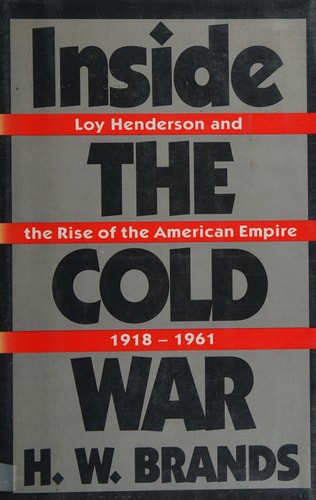
Inside the Cold War: Loy Henderson and the Rise of the American Empire, 1918-1961
0
0
As an Amazon Associate and affiliate partner, Menrva Books earns from qualifying purchases. Learn more
Author Description
Although less remembered than some of his colleagues, American diplomat Loy Henderson often stood in the thick of controversy during his distinguished forty-year career. An uncompromising and frequently contentious anti-communist, Henderson left his unmistakable imprint on many crucial policy decisions, ranging from the delay of recognition of the Soviet Union in the 1920s and 1930s, to the Truman doctrine of the 1940s, to the overthrow of the Mosadeq government of Iran during the 1950s. Now, in this fascinating biography, H.W. Brands recounts Loy Henderson's far-flung diplomatic career and, in doing so, opens a window onto the entire Cold War Era.Henderson's ascent to a position of major influence among American foreign-policy makers paralleled the rise of the United States to unprecedented influence in global affairs, with anti-communism providing much of the impetus and rationale in both cases. Henderson acquired his life-long preoccupation with the communist menace--a preoccupation that reflected his psychological make-up and personal history, as well as the objective actions of Soviet leaders--in Moscow in the mid-1930s, when he served with the first group of American diplomats posted to the Soviet Union. He witnessed directly the terror and brutality of the Stalinist system, and he spent the rest of his career agitating against anything that might facilitate the spread of that system. Henderson's refusal to compromise his convictions threw him repeatedly into conflict with his superiors--as during World War II, when he warned that Soviet cooperation was a cynical and passing phenomenon, and in the fight over American support for the creation of Israel, when he predicted that American backing for the Zionists would alienate the Arabs and lay the Middle East open to Soviet penetration. In each instance, Henderson's outspokenness led to professional exile; but each time he succeeded in working his way back to the center of the decision-making process.
Menrva's Summary
THE THESIS
How did the career of diplomat Loy Henderson shape the trajectory of American foreign policy and the global expansion of United States influence during the Cold War? H.W. Brands, a historian specializing in American foreign policy, utilizes archival records and diplomatic correspondence to examine Henderson's role as a key architect of anti-communist strategy. The book argues that Henderson's personal experiences in the Soviet Union during the 1930s created a rigid ideological framework that influenced U.S. policy decisions from the Truman Doctrine to the intervention in Iran.
THE SCOPE MAP
What You Will Find
- A detailed examination of American diplomatic history from 1918 to 1961.
- Analysis of the development of the Truman Doctrine and containment policy.
- Primary source evidence including diplomatic cables, personal letters, and government records.
- An investigation into the psychological and historical roots of anti-communist sentiment within the U.S. State Department.
THE AUTHORITY PERSPECTIVE
Historians and political scientists frequently cite this work as a significant contribution to understanding the internal mechanics of the American diplomatic corps during the mid-twentieth century. Experts highlight the text for its balanced portrayal of a polarizing figure and its clear articulation of the bureaucratic conflicts that defined the early Cold War era.
Page Count:
352
Publication Date:
1991-04-18
Publisher:
Oxford University Press
ISBN-10:
019506707X
ISBN-13:
9780195067071
Biography
History
International relations
Cold War
Diplomats
Diplomacy
United States
Community Tags
Similar Books