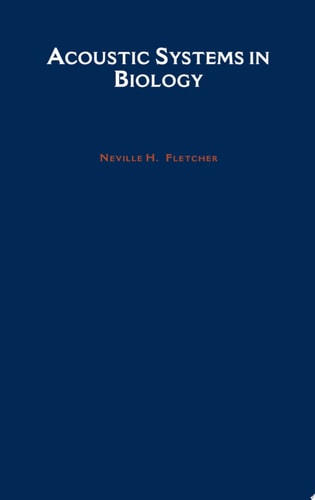
Acoustic Systems in Biology
0
0
As an Amazon Associate and affiliate partner, Menrva Books earns from qualifying purchases. Learn more
Author Description
This book is a practical guide for researchers and advanced graduate students in biology and biophysics who need a quantitative understanding of acoustical systems such as hearing, sound production, and vibration detection in animals at the physiological level. It begins with an introduction to physical acoustics, covering the fundamental concepts and showing how they can be applied quantitatively to understand auditory and sound-producing systems in animals. Only after the relatively simple mechanical part of the system is explained does the author focus his attention on the underlying physiological processes. The book is written on three levels. For those wanting a brief survey of the field, each chapter begins with a nonmathematical synopsis which summarizes the content and refers to the figures, all of which are designed to be understood apart from the main text. At the next level, the reader can follow the main text, but need not give close attention to anything but the general concepts and techniques involved. At the third level, the reader should follow the mathematical arguments in detail and attempt the discussion of questions at the end of each chapter. The author has provided detailed solutions which serve to expand the discussions of particular cases.
Menrva's Summary
THE THESIS
This book investigates the quantitative physical principles governing acoustic systems in biological organisms, specifically focusing on hearing, sound production, and vibration detection. Neville H. Fletcher, an expert in the physics of acoustics, provides a structured framework that bridges the gap between physical acoustics and physiological function. By applying mechanical principles to animal systems, the text offers a rigorous methodology for researchers and graduate students to analyze biological sound mechanisms.
THE SCOPE MAP
What You Will Find
- Fundamental concepts of physical acoustics applied to biological systems
- Quantitative analysis of auditory and sound-producing mechanisms in animals
- A tiered pedagogical structure featuring non-mathematical synopses and detailed mathematical derivations
- End-of-chapter discussion questions with comprehensive solutions for advanced study
THE AUTHORITY PERSPECTIVE
Experts recognize this work as a foundational text for those bridging the gap between physics and biology. Readers frequently note the high level of mathematical rigor, which makes it a demanding but rewarding resource for advanced students and researchers in the field.
Page Count:
352
Publication Date:
1992-07-23
Publisher:
Oxford University Press
ISBN-10:
0195069404
ISBN-13:
9780195069402
Science
Acoustics
Biology
Bioacoustics
Physiology
Zoology
Biophysics
Community Tags
Other Editions(2)

Similar Books