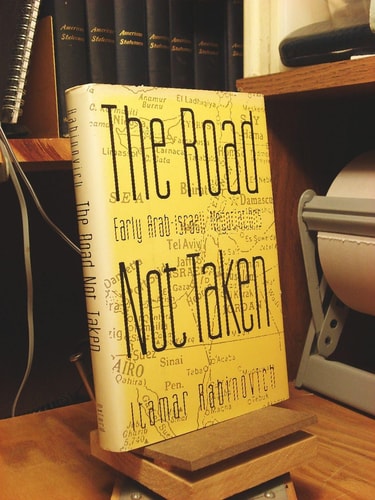
The Road Not Taken: Early Arab-Israeli Negotiations
0
0
As an Amazon Associate and affiliate partner, Menrva Books earns from qualifying purchases. Learn more
Author Description
For five decades, the Arab world has technically been in a state of war with Israel--a pattern broken only by Cairo's Camp David accord with Jerusalem. No conflict in international politics has seemed more intractable. But for a few brief years after Israel's War of Independence, the Jewish and Arab states engaged in direct negotiations that came tantalizingly close to a permanent settlement. In The Road Not Taken, Itamar Rabinovich mines a wealth of new sources to reconstruct those critical talks, showing how close they came to success, and how their failure laid the grounds for the current impasse.In the aftermath of the 1948 war, Rabinovich writes, the seeds of the present turmoil in the Middle East were sown: confused and debated borders, hundreds of thousands of Arab refugees, internal struggles over each government's political agenda. In 1949, the Arab world was divided as never before--Iraq and Transjordan were at odds with Saudi Arabia and Egypt--and each state wrestled with its own negotations with Israel. King Abdallah of Transjordan negotiated with Israel with an eye toward siezing what is now called the West Bank and--ultimately--the Hejaz in the Arabian Peninsula. The region's first military dictator, Husni al-Zaim of Syria, offered an intriguing, if illusory, opening, as he sought a permanent settlement with Israel so he could concentrate on internal issues. Zaim, the book shows, was allied to the U.S. intelligence community. Egypt approached the armistice talks with its own goals in mind, seeking the southern Negev desert and other gains. Behind the scenes stood the region's last imperial power, Great Britain, whose manipulations were suspected by all parties even where they did not exist. And farther back loomed the U.S., about to succeed Britain as the dominant Western power in the region. Within Israel, fierce debates raged over how to handle negotiations (echoing clearly in our own time), some favoring a settlement with Amman based on a recognitio
Menrva's Summary
THE THESIS
This work investigates why the early post-1948 Arab-Israeli negotiations failed to produce a lasting peace, despite coming remarkably close to a settlement. Itamar Rabinovich, a former Israeli ambassador and expert on Middle Eastern history, utilizes newly available archival sources to reconstruct the complex diplomatic landscape of 1949. He argues that the internal political instability of the Arab states, combined with competing regional agendas and the shifting influence of Western powers, created an impasse that continues to define the conflict today.
THE SCOPE MAP
What You Will Find
- Detailed analysis of the 1949 armistice negotiations between Israel, Transjordan, Syria, and Egypt.
- Examination of the geopolitical influence exerted by Great Britain and the United States during the transition of regional power.
- Primary source evidence including diplomatic correspondence and intelligence reports regarding key figures like King Abdallah and Husni al-Zaim.
- A framework for understanding how the unresolved issues of 1949, such as border disputes and refugee crises, established the foundation for modern Middle Eastern turmoil.
THE AUTHORITY PERSPECTIVE
Experts recognize this text as a foundational study for understanding the missed opportunities of early Arab-Israeli diplomacy. Readers frequently note the academic rigor and the clarity with which Rabinovich navigates the dense political maneuvering of the post-war period.
Page Count:
272
Publication Date:
1991-10-10
Publisher:
Oxford University Press
ISBN-10:
0195060660
ISBN-13:
9780195060669
History
Jewish-Arab relations
International relations
Middle East
Diplomacy
Community Tags
Similar Books