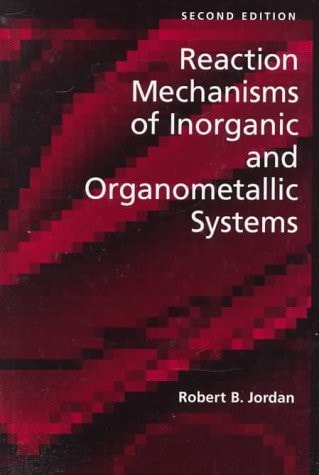
Reaction Mechanisms of Inorganic and Organometallic Systems
0
0
As an Amazon Associate and affiliate partner, Menrva Books earns from qualifying purchases. Learn more
Author Description
This book is intended as a chemistry text for a one-semester course on inorganic reaction mechanisms at the advanced undergraduate or graduate level. Introductory chapters concentrate on the collection and interpretation of kinetic data. The chapter on substitution reactions begins with the Langford and Gray classification system and focuses on a sensible approach to mechanistic discussions. Current experimental and theoretical information on solvent exchange reactions is emphasized for substitution on labile systems. Standard stereochemical change processes are discussed, along with a simplified approach to symmetry rules for fluxional organometallic systems. The area of organometallic reactions attempts to bring together and generalize the current work on a variety of common reactions in this area, including C-H activation and a selection of catalytic processes. Electron transfer reactions are discussed in terms of current modifications of Marcus' theory and ideas about bridging ligand effects, including intravalence electron transfer. In inorganic photochemistry, the general factors affecting quantum yields are discussed, with applications to cobalt (III), chromium (III) and rhodium (III) systems, along with flash photolysis and matrix isolation studies in organometallic photochemistry. Selected bioinorganic systems are discussed in detail. The text includes over 500 references to original literature through 1990, and sample problems for each chapter.
Menrva's Summary
THE THESIS
This text investigates the fundamental kinetic and mechanistic principles governing inorganic and organometallic chemical reactions. Robert B. Jordan provides a structured framework for advanced undergraduate and graduate students to interpret kinetic data and apply theoretical models to complex reaction systems. By synthesizing experimental findings with established chemical theories, the book serves as a comprehensive guide for analyzing reaction pathways in both coordination and organometallic chemistry.
THE SCOPE MAP
What You Will Find
- Kinetic data collection and interpretation methodologies
- Analysis of substitution reactions using the Langford and Gray classification system
- Theoretical applications of Marcus theory to electron transfer processes
- Examination of fluxional organometallic systems and symmetry rules
- Detailed case studies on bioinorganic systems and inorganic photochemistry
THE AUTHORITY PERSPECTIVE
Experts recognize this work as a foundational resource for students specializing in inorganic reaction mechanisms. Readers frequently note the academic density of the prose and the utility of the extensive literature references provided for further research.
Page Count:
304
Publication Date:
1991-09-19
Publisher:
Oxford University Press
ISBN-10:
0195069455
ISBN-13:
9780195069457
Science
textbook
Inorganic compounds
Chemistry
Inorganic Chemistry
Chemical reaction Conditions and laws of
Community Tags
Other Editions(4)
Similar Books
Reader Comments
Share Your Thoughts
No comments yet. Be the first to share your thoughts!