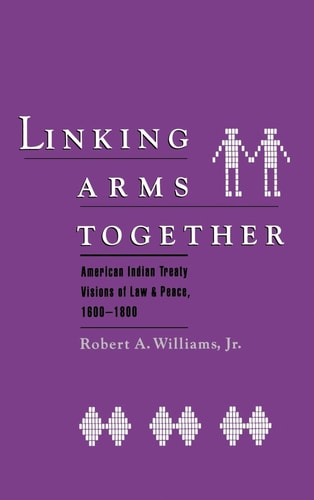
Linking Arms Together: American Indian Treaty Visions of Law and Peace, 1600-1800
0
0
As an Amazon Associate and affiliate partner, Menrva Books earns from qualifying purchases. Learn more
Author Description
Robert Williams attempts to write Indians back into Indian law by developing a greater appreciation for the contributions of American Indian legal visions and demonstrating how ancient treaty visions can speak to the modern, multicultural age. Prior to European colonization, in countless treaties, councils, and negotiations, American Indians had adhered to the principles contained in traditional rituals such as the Gus-Wen-Tah, the sacred treaty belt, for achieving justice between different peoples. Throughout the seventeenth and eighteenth centuries, the survival of the European colonies in North America required reaching accommodation with surrounding Indian tribes. However, European Common law and the white man's Indian law eventually became dominant, and came to be regarded as the salvation of the Indian in North America.Williams maintains there is an important need for a more complete account of the legal visions of the American Indians. In this work, he examines the Indians' role in the history of legal traditions which have determined Indian rights in the U.S., including the Indian conceptions of justice, their traditions, and practices. Doing so is essential to protecting Indian tribalism's survival under U.S. law. In addition, understanding how the American Indian legal traditions have worked to help perpetuate Indian tribalism might also assist in beginning to understand how U.S. law may achieve racial justice more generally.
Menrva's Summary
THE THESIS
This work investigates how American Indian legal traditions and treaty visions, often overlooked in standard historical accounts, provided foundational frameworks for justice and peace in North America between 1600 and 1800. Robert A. Williams Jr., a legal scholar, utilizes historical treaty records and indigenous oral traditions to challenge the dominance of European Common Law in the American legal narrative. He argues that integrating these indigenous perspectives is necessary for both the survival of tribal sovereignty and the broader pursuit of racial justice within the modern United States legal system.
THE SCOPE MAP
What You Will Find
- Analysis of indigenous treaty rituals, including the Gus-Wen-Tah sacred treaty belt.
- Examination of the legal interactions between European colonial powers and North American Indian tribes.
- Historical documentation of seventeenth and eighteenth-century diplomatic negotiations.
- A critical framework for incorporating indigenous legal philosophy into contemporary U.S. jurisprudence.
THE AUTHORITY PERSPECTIVE
Legal scholars and historians frequently cite this text as a foundational contribution to the field of Federal Indian Law. Experts highlight the author's ability to synthesize complex legal history with indigenous philosophy to challenge established colonial-centric narratives.
Page Count:
208
Publication Date:
1997-03-20
Publisher:
Oxford University Press
ISBN-10:
0195065913
ISBN-13:
9780195065916
History
North America
Law
Government relations
Community Tags
Similar Books