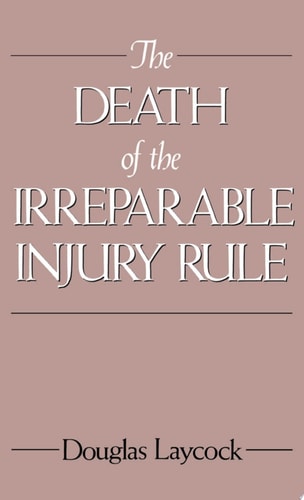
The Death of the Irreparable Injury Rule
0
0
As an Amazon Associate and affiliate partner, Menrva Books earns from qualifying purchases. Learn more
Author Description
The irreparable injury rule says that courts will not grant an equitable remedy to prevent harm if it would be adequate to let the harm happen and grant the legal remedy of money damages. After surveying more than 1400 cases, Laycock concludes that this ancient rule is dead--that it almost never affects the results of cases. When a court denies equitable relief, its real reasons are derived from the interests of defendants or the legal system, and not from the adequacy of the plaintiff's legal remedy. Laycock seeks to complete the assimilation of equity, showing that the law-equity distinction survives only as a proxy for other, more functional distinctions. Analyzing the real rules for choosing remedies in terms of these functional distinctions, he clarifies the entire law of remedies, from grand theory down to the practical details of specific cases. He shows that there is no positive law support for the most important applications of the legal-economic theory of efficient breach of contract. Included are extensive notes and a detailed table of cases arranged by jurisdiction.
Menrva's Summary
THE THESIS
Does the irreparable injury rule actually dictate the outcomes of modern judicial decisions regarding equitable remedies? Douglas Laycock, a prominent legal scholar, examines over 1,400 cases to argue that the traditional rule—which prioritizes monetary damages over equitable relief—is effectively obsolete in practice. He posits that courts rely on functional interests rather than the adequacy of legal remedies, ultimately seeking to dismantle the historical divide between law and equity.
THE SCOPE MAP
What You Will Find
- Empirical analysis of over 1,400 judicial cases across various jurisdictions.
- A critical evaluation of the legal-economic theory of efficient breach of contract.
- A comprehensive framework for understanding the functional rules that actually govern remedy selection.
- Extensive scholarly notes and a detailed table of cases for legal research.
THE AUTHORITY PERSPECTIVE
Legal scholars and practitioners recognize this work as a foundational text for understanding the modern application of equitable remedies. Readers frequently note the academic density of the prose, which provides a rigorous challenge to traditional legal doctrines.
Page Count:
382
Publication Date:
1991-01-17
Publisher:
Oxford University Press
ISBN-10:
0195063562
ISBN-13:
9780195063561
Damages
Legal Theory
Injunctions
Remedies
Contract law
Law
Jurisprudence
Community Tags
Similar Books