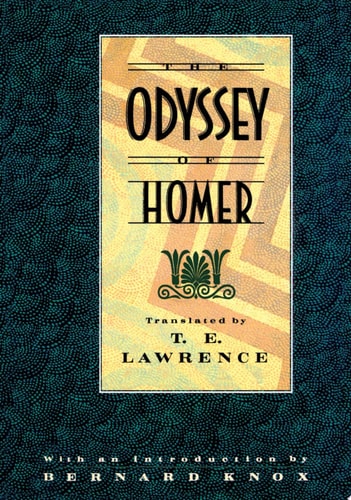
The Odyssey of Homer: Translated by T.E. Lawrence
0
0
As an Amazon Associate and affiliate partner, Menrva Books earns from qualifying purchases. Learn more
Author Description
Colonel T.E. Lawrence was one of the most flamboyant figures of his era, known throughout the Western world as Lawrence of Arabia. Glory-seeking yet self-effacing, this soldier, archaeologist, spy, and scholar was a war hero whom Winston Churchill called "one of the greatest men of our time." Less well known were his abilities as historian and author, which won him the admiration of such writers as Ezra Pound, W.H. Auden, and Robert Graves.While stationed on a desolate R.A.F. outpost on the fringes of the Karachi desert in India, Lawrence began his acclaimed translation of The Odyssey. He devoted himself to the project for four years, and during that time he came to feel that he was uniquely suited to the task. "I have hunted wild boars and watched wild lions," he wrote. "Built boats and killed many men. So I have odd knowledges that qualify me to understand The Odyssey, and odd experiences that interpret it to me." Relying on an innate sense of language and truly gifted abilities at translation, Lawrence transformed Homer's Odyssey into mellifluous prose. The result was an overnight bestseller. The New York Herald Tribune hailed it "perhaps the most interesting translation of the world's most interesting book," and The New York Times called it "ruggedly and roughly masculine" and added that it "gives a vividness to the story beyond any other text familiar to us."Lawrence breathes new life into the adventures of Odysseus, smoothing the reader's path through a fantastic array of monsters, temptresses, gods, and goddesses. For a generation of readers accustomed to verse translations of Homer, this bold and vivid prose version is well worth rediscovery.
Menrva's Summary
THE PULSE
The central conflict involves the hero Odysseus struggling to return home to Ithaca following the conclusion of the Trojan War while facing the wrath of the gods. Odysseus must navigate a series of perilous encounters with supernatural entities, vengeful deities, and treacherous environments that threaten to prevent his reunion with his wife, Penelope, and his son, Telemachus. The narrative follows a non-linear structure, utilizing flashbacks and nested storytelling to recount the hero's decade-long ordeal. Lawrence’s translation emphasizes a masculine, direct prose style that strips away the artifice often found in traditional verse renderings to highlight the raw survivalist nature of the protagonist's quest.
INSIDE THE PAGES
- Utilization of modern, rhythmic prose to replace traditional epic verse structures.
- Inclusion of supernatural encounters with figures such as Circe, Calypso, and the Cyclops.
- Focus on the themes of nostos, or the homecoming, and the endurance of the human spirit.
- Detailed descriptions of ancient maritime navigation and Mediterranean geography.
- Exploration of the complex power dynamics between mortal heroes and the Olympian pantheon.
- Emphasis on the cunning and strategic intellect of Odysseus as his primary weapon.
- Integration of cultural values regarding hospitality, loyalty, and vengeance.
- Use of vivid, sensory language to depict the harsh realities of ancient warfare and travel.
THE COLLECTIVE ECHO
Readers and critics frequently highlight the unique perspective T.E. Lawrence brings to this translation, noting that his own background as a soldier and traveler informs the rugged tone of the prose. Discussion often centers on the accessibility of this version compared to more academic or archaic translations that rely on rigid meter. Many observers appreciate how the text maintains the intensity of the original epic while removing the barriers that often alienate modern readers. The work is frequently cited for its ability to render the ancient world with a visceral, immediate quality that feels both timeless and distinctively personal to the translator's own experiences.
Page Count:
352
Publication Date:
1991-07-25
Publisher:
Oxford University Press
ISBN-10:
0195068181
ISBN-13:
9780195068184
Adventure
classic
English poetry
Mythology
Ancient Greek
Epic Poetry
Community Tags
Similar Books