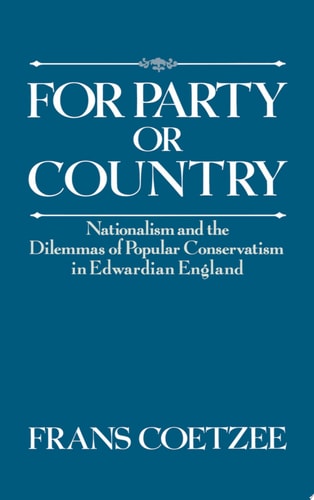
For Party or Country: Nationalism and the Dilemmas of Popular Conservatism in Edwardian England
0
0
As an Amazon Associate and affiliate partner, Menrva Books earns from qualifying purchases. Learn more
Author Description
Lord Hugh Cecil, commenting in 1912 on the British Conservative party's staying power, said that the party's success was largely a matter of temperament, "recruited from...the natural conservatism that is found in almost every human mind." The Conservatives regarded the parties of the left as faddists or federations of pressure groups. In this thorough analysis, Coetzee examines the condition of the Conservative party during the two decades preceding World War I--a transitional period for the party, marked by the foundation of an unprecedented number of conservative pressure groups. Cecil's comment, Coetzee argues, obscures the extent to which conservative pressure groups forced their party to adapt in Edwardian England. The British Navy League, the Tariff Reform League, the Anti-Socialist Union, and a host of other groups changed the face of British conservatism, though not without considerable internal party conflict. In addition to providing a complete account of the pressure groups' origins, organizations, successes, and failures, Coetzee ties their histories to the debates within the Conservative party itself, and to the local elections. In so doing, he demonstrates how the party of the right was ultimately able to convince the electorate that its views were more "national" and "patriotic" than those of the parties of the left.
Menrva's Summary
THE THESIS
This book investigates how the emergence of diverse conservative pressure groups fundamentally reshaped the British Conservative Party's identity and electoral strategy during the Edwardian era. Frans Coetzee, a historian specializing in British political development, utilizes archival records and contemporary political discourse to challenge the notion that the party's success was merely a product of inherent human temperament. Instead, he argues that the party was forced to adapt to the influence of organized interest groups, which ultimately allowed the Conservatives to claim the mantle of national patriotism against their political rivals.
THE SCOPE MAP
What You Will Find
- Analysis of influential organizations including the British Navy League, the Tariff Reform League, and the Anti-Socialist Union.
- Examination of the internal conflicts between traditional party leadership and emerging grassroots pressure groups.
- Integration of local election data and national political debates to track shifting voter sentiment.
- A detailed historical account of the organizational structures and strategic failures of early twentieth-century conservative movements.
THE AUTHORITY PERSPECTIVE
Historians and political scientists frequently cite this work as a definitive study on the evolution of party politics in pre-World War I Britain. Scholars note the text's rigorous use of primary sources to explain the complex relationship between institutional party structures and external political advocacy groups.
Page Count:
240
Publication Date:
1990-06-28
Publisher:
Oxford University Press
ISBN-10:
0195062388
ISBN-13:
9780195062380
History
Conservatism
British History
Great Britain
Edwardian Era
Community Tags
Similar Books