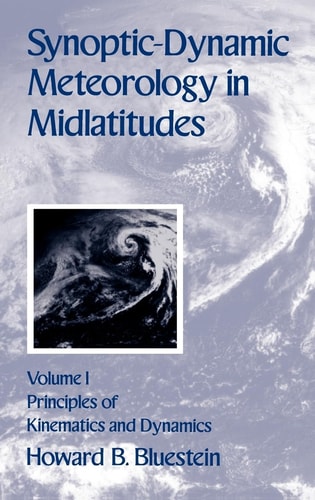
Synoptic-Dynamic Meteorology in Midlatitudes: Principles of Kinematics and Dynamics, Vol. 1
0
0
As an Amazon Associate and affiliate partner, Menrva Books earns from qualifying purchases. Learn more
Author Description
This new, comprehensive textbook for upper-division undergraduate and graduate students of meteorology presents for the first time information that is now considered essential in modern weather forecasting. Based on a successful series of courses taught by the author at the University of Oklahoma, the text carefully examines the foundations of synoptic meteorology, from the analysis of scalar fields to atmospheric kinematics, dynamics, and thermodynamics. Newer topics such as Q-vectors, and modern observing systems such as Doppler radar are discussed, and several detailed figures and many helpful problems are included. This timely work emphasizes both physical understanding and mathematical analysis, and clearly explains observations in light of current theory. It will be a valuable reference for weather forecasters and researchers as well as students.
Menrva's Summary
THE THESIS
This volume investigates the fundamental principles of synoptic and dynamic meteorology required to understand midlatitude weather systems. Howard B. Bluestein, a professor at the University of Oklahoma, synthesizes decades of instructional experience to provide a rigorous mathematical and physical framework for analyzing atmospheric motion. The text bridges the gap between classical theory and modern observational techniques, utilizing a structured approach to kinematics, dynamics, and thermodynamics to explain complex weather phenomena.
THE SCOPE MAP
What You Will Find
- Comprehensive analysis of scalar fields and atmospheric kinematics.
- Theoretical foundations of dynamics and thermodynamics in the midlatitudes.
- Technical discussion of modern observing systems including Doppler radar.
- Practical application of Q-vectors in contemporary weather forecasting.
THE AUTHORITY PERSPECTIVE
Experts recognize this work as a foundational text for graduate-level atmospheric science curricula. Readers frequently note the high level of mathematical density, which requires a strong background in calculus and physics to fully comprehend the presented theories.
Page Count:
448
Publication Date:
1992-05-21
Publisher:
Oxford University Press
ISBN-10:
0195062671
ISBN-13:
9780195062670
Science
Dynamics
Meteorology
Physics
Atmospheric Science
textbook
Community Tags
Similar Books