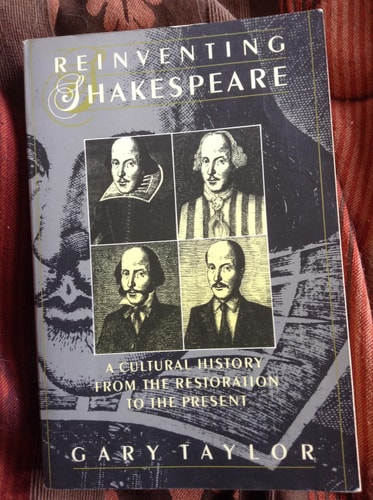
Reinventing Shakespeare: A Cultural History from the Restoration to the Present
0
0
As an Amazon Associate and affiliate partner, Menrva Books earns from qualifying purchases. Learn more
Author Description
As an actor, William Shakespeare reinvented himself almost every day. At the height of his career, he often performed in six different plays on six consecutive days. He stopped reinventing himself when he died on April 23, 1616, but, as Gary Taylor tells us in this bold, provocative, irreverent history of Shakespeare's reputation through the ages, we have been reinventing him ever since.Taylor, who sparked a worldwide controversy in 1985 by announcing his discovery of a "new" Shakespeare poem "Shall I die?," presents a brilliantly argued, wryly humorous discussion of the ways in which society "reinvents" Shakespeare--and to some extent all great literature--to suit its own ends. He reveals how Shakespeare's reputation has benefited from such diverse and unpredictable factors as the dearth of new plays after the Restoration; the decline of tragedy in the eighteenth century, when, as Taylor puts it, "Shakespeare was kept on the menu because he was the only serious dish [the repertoire companies] knew how to cook"; the changing social status of women in the nineteenth century; England's longstanding rivalry with France, which turned Shakespeare into the great advocate of conservative British values; and the current trend in academia toward shockingly unorthodox views, which has turned Shakespeare into the great ally of radical Marxist and feminist critics.Through the centuries, critics have cited the same Shakespeare--often the very same play--as the supporter of a vast array of world views. Examining each period's method of invoking the Bard's "greatness" to support a series of conflicting values, Taylor questions what actually constitutes greatness. He insists on examining the criteria of each epoch on its own terms in order to demonstrate how literary criticism can often become the most telling form of social commentary. Reinventing Shakespeare offers nothing less than a major reevaluation of Shakespeare, his writing, his place in world history, and the very bases o
Menrva's Summary
THE THESIS
This book investigates how the reputation of William Shakespeare has been continuously reconstructed by successive generations to serve shifting cultural, political, and social agendas. Gary Taylor, a prominent Shakespearean scholar, utilizes historical analysis and literary reception theory to argue that the concept of the 'Bard' is a malleable construct. By examining the evolution of Shakespearean criticism from the Restoration to the modern era, Taylor demonstrates that literary greatness is often a reflection of the values held by the society interpreting the work rather than an inherent quality of the texts themselves.
THE SCOPE MAP
What You Will Find
- A chronological analysis of Shakespearean reception from the 17th century to the late 20th century.
- Examination of how political rivalries, such as the Anglo-French conflict, influenced the canonization of Shakespeare.
- Case studies on the impact of changing social norms, including the roles of women and the rise of Marxist and feminist critical frameworks.
- A critical methodology for evaluating how literary criticism functions as a form of social commentary.
THE AUTHORITY PERSPECTIVE
Experts recognize this work as a significant contribution to the field of reception history, noting its provocative and irreverent tone. Readers frequently highlight the text's ability to challenge traditional notions of literary value while providing a rigorous historical account of how Shakespearean scholarship has evolved over time.
Page Count:
480
Publication Date:
1991-03-07
Publisher:
Oxford University Press
ISBN-10:
0195066790
ISBN-13:
9780195066791
History
Non-Fiction
Shakespeare
Literary Criticism
Community Tags
Similar Books