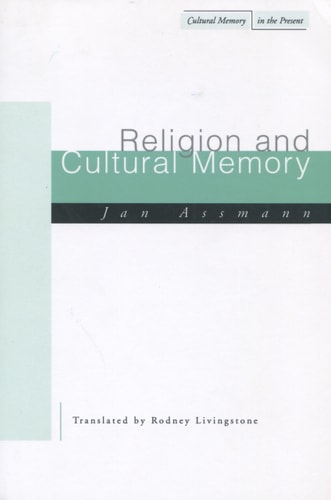
Religion and Cultural Memory: Ten Studies
0
0
As an Amazon Associate and affiliate partner, Menrva Books earns from qualifying purchases. Learn more
Author Description
In ten brilliant essays, Jan Assmann explores the connections between religion, culture, and memory. Building on Maurice Halbwachs's idea that memory, like language, is a social phenomenon as well as an individual one, he argues that memory has a cultural dimension too. He develops a persuasive view of the life of the past in such surface phenomena as codes, religious rites and festivals, and canonical texts on the one hand, and in the Freudian psychodrama of repressing and resurrecting the past on the other. Whereas the current fad for oral history inevitably focuses on the actual memories of the last century or so, Assmann presents a commanding view of culture extending over five thousand years. He focuses on cultural memory from the Egyptians, Babylonians, and the Osage Indians down to recent controversies about memorializing the Holocaust in Germany and the role of memory in the current disputes between Israelis and Palestinians in the Middle East and between Protestants and Catholics in Northern Ireland.
Menrva's Summary
THE THESIS
This collection examines the intricate relationship between religion, culture, and the enduring power of collective memory across millennia. Jan Assmann, drawing on Maurice Halbwachs, posits memory as a social construct, extending its influence from ancient civilizations like Egypt and Babylonia to contemporary global conflicts. He investigates how religious rites, canonical texts, and even the repression and resurrection of the past shape cultural memory over five thousand years, offering a broad perspective that contrasts with the limited scope of oral history.
THE SCOPE MAP
- Exploration of Maurice Halbwachs's theories on social memory.
- Analysis of religious rites, festivals, and canonical texts as manifestations of cultural memory.
- Examination of the Freudian psychodrama of repressing and resurrecting the past.
- Historical scope spanning five thousand years, from ancient Egypt and Babylonia.
- Case studies including the Osage Indians, Holocaust memorialization in Germany, and contemporary conflicts in the Middle East and Northern Ireland.
THE AUTHORITY PERSPECTIVE
The essays in Religion and Cultural Memory are lauded for their intellectual rigor and expansive historical scope, offering a profound synthesis of religious studies, cultural history, and memory theory. Assmann's work is recognized for its ability to connect ancient practices to modern socio-political issues, providing a framework for understanding how collective memory shapes identity and conflict. The collection is considered a significant contribution to the study of cultural memory, challenging conventional approaches by emphasizing long-term historical perspectives. Scholars appreciate its nuanced exploration of religion's role in constructing and maintaining shared pasts.
Page Count:
240
Publication Date:
2005-11-15
Publisher:
Stanford University Press
ISBN-10:
0804745226
ISBN-13:
9780804745222
Religion
History
Non-Fiction
Sociology
Community Tags
Similar Books