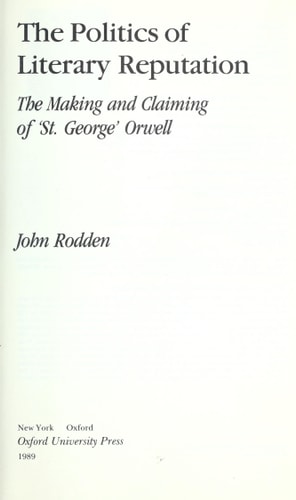
The Politics of Literary Reputation: The Making and Claiming of 'St. George' Orwell
0
0
As an Amazon Associate and affiliate partner, Menrva Books earns from qualifying purchases. Learn more
Author Description
Lionel Trilling memorialized him as "a virtuous man." To Arthur Koestler his life was "a rebel's progress." Irving Howe called him "my intellectual hero"; and V.S. Pritchett eulogized him as a "saint" and the "conscience of his generation." Since his death in 1950, George Orwell has served as a personal and intellectual model for countless writers across the political spectrum, ranging from the New Left to the New York intellectuals to the National Review conservatives. His last two books, Animal Farm and Nineteen Eighty-Four, have sold forty million copies in sixty-five languages, more than any other pair of books by a single author in history. How did this enormous reputation develop? And what can Orwell's reputation tell us about reputation-building in general?As the first systematic exploration of reputation as a literary and sociological issue, The Politics of Literary Reputation addresses these questions. In the process of telling the story of how Orwell's reputation was made and maintained, John Rodden breaks new ground on a host of topics connected with the phenomenon of fame (literary heroism, intellectual role-modeling, political grave-robbing, literary canon-formation). Through this fascinating account of the posthumous history of the best-selling political writer of the century, Rodden has, in a sense, invented a new way of writing the traditional "Life and Times" biography: telling the story of a person's "afterlife."Using the vicissitudes of Orwell's reputation as a giant lens through which to behold a history of the events he has influenced, Rodden achieves nothing less than a kaleidoscopic biography of the postwar West. He discusses how the recent Soviet publication of Nineteen Eighty-Four unveils some of the paradoxes of perestroika; how the first BBC-TV adaptation of Nineteen Eighty-Four in 1954 signaled the changing conditions of reputation-building in the media age; how Orwell's exclusion from the "high canon" of modern British literature reflect
Menrva's Summary
THE THESIS
This work investigates the mechanisms behind the construction and maintenance of George Orwell's posthumous reputation as a cultural and political icon. John Rodden, a scholar of literary history, utilizes a sociological framework to analyze how Orwell’s identity was shaped, contested, and appropriated by diverse political factions following his death in 1950. By examining the intersection of literary canon-formation and intellectual role-modeling, the author argues that Orwell’s fame serves as a unique case study for understanding the broader phenomenon of literary celebrity in the postwar West.
THE SCOPE MAP
What You Will Find
- An analysis of the sociological factors influencing literary reputation and canon-formation.
- A historical examination of how Orwell’s works were utilized by both the New Left and conservative intellectuals.
- Case studies on the media adaptation of Orwell’s novels and their impact on his public image.
- A methodological approach to writing an 'afterlife' biography that tracks the posthumous influence of a public figure.
THE AUTHORITY PERSPECTIVE
Scholars and critics frequently cite this text as a foundational study in the sociology of literature and the mechanics of posthumous fame. Readers often note the academic rigor and the extensive research Rodden employs to map the complex political appropriation of Orwell’s legacy.
Page Count:
496
Publication Date:
1991-01-10
Publisher:
Oxford University Press
ISBN-10:
0195067118
ISBN-13:
9780195067118
Biography
History
Literary Criticism
Sociology
Community Tags
Similar Books