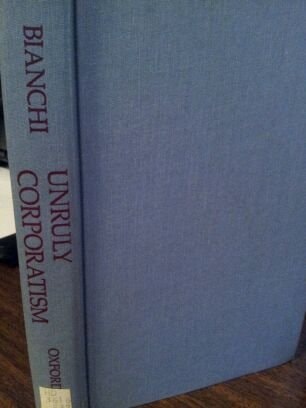
Unruly Corporatism: Associational Life in Twentieth-Century Egypt
0
0
As an Amazon Associate and affiliate partner, Menrva Books earns from qualifying purchases. Learn more
Author Description
The power of Egypt's authoritarian state has been eroded by assertive associations demanding greater democracy, economic nationalism, and cultural diversity. Spotlighting the growing importance in Egypt of professional syndicates, labor unions, agricultural cooperatives, businessperson's associations, and religious groups, this study examines the increasing vitality of Egyptian civil society. Bianchi shows how Anwar Sadat's attempt to replace these associations with rigid corporatist controls contributed to his downfall just as similar policies undermined other authoritarian regimes in Iran, South Korea, and India.
Menrva's Summary
THE THESIS
This study investigates how the emergence of assertive civil associations in twentieth-century Egypt challenged the stability of authoritarian state structures. Robert R. Bianchi, a scholar of Middle Eastern politics, utilizes historical analysis and political theory to argue that state-imposed corporatist controls often backfire, creating political volatility rather than order. By examining the tension between state authority and independent organizations, the author demonstrates how the suppression of civil society contributed to the political decline of leaders like Anwar Sadat.
THE SCOPE MAP
What You Will Find
- Analysis of professional syndicates, labor unions, and agricultural cooperatives in Egypt.
- Comparative study of corporatist control mechanisms in Iran, South Korea, and India.
- Examination of the political impact of religious groups and business associations.
- Evaluation of the transition from state-led control to democratic demands within civil society.
THE AUTHORITY PERSPECTIVE
Experts in Middle Eastern political science recognize this work as a foundational text for understanding the dynamics of Egyptian civil society during the twentieth century. Readers frequently note the academic density of the prose and the depth of the comparative political analysis provided by the author.
Page Count:
280
Publication Date:
1989-11-09
Publisher:
Oxford University Press
ISBN-10:
0195060318
ISBN-13:
9780195060317
History
Corporate State
Sociology
Egypt
Community Tags
Similar Books