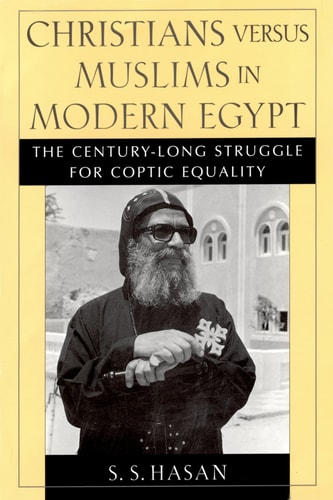
Christians versus Muslims in Modern Egypt: The Century-Long Struggle for Coptic Equality
0
0
As an Amazon Associate and affiliate partner, Menrva Books earns from qualifying purchases. Learn more
Author Description
The Copts of Egypt are the largest Christian minority in the Middle East. In recent years they have often figured in the news as victims of bloody attacks by Islamic militants.Christians versus Muslims in Modern Egypt is the first study of Christian identity politics in contemporary Egypt. S.S. Hasan begins by looking at how the Coptic generation of the 1940s and 1950s remembered, recovered, and imagined the ancient history of Christianity in Egypt in order to weld the Copts into a unified nation, resistant to the growing encroachments of Islam. She argues that this interpretation of history, in which Egyptian martyrs figure prominently, made possible the rebirth of the Coptic church and community-in much the same way as the preservation of Hebrew and the historical memory of Jewish tribulations served the purpose of national reconstruction of the state of Israel.The bulk of the book focuses on the period beginning with the consecration of Pope Shenuda in 1971. Drawing on extensive interviews with church leaders, clergy, and others Hasan finds that during this period the responsibilities of the church for the welfare of the Coptic community grew immeasurably. Church leaders arrogated to themselves the exclusive right to the political representation of their community and reconceived their role from the narrow care of souls to the promotion of economic and cultural efflorescence of the entire Coptic community. The leaders of this revival, she shows, have nurtured a potent and distinctive religious culture with a sense of communal pride and identity in an environment in which they were increasingly exposed to discrimination and outright hostility.
Menrva's Summary
THE THESIS
This study investigates the evolution of Coptic Christian identity politics in Egypt and the mechanisms used to foster communal unity amidst increasing social and religious tension. S.S. Hasan, an expert in Middle Eastern studies, utilizes historical analysis and extensive field interviews to examine how the Coptic community reconstructed its historical narrative to resist marginalization. The author argues that the church transitioned from a purely spiritual institution to a comprehensive political and economic representative for its members, particularly following the 1971 consecration of Pope Shenuda.
THE SCOPE MAP
What You Will Find
- Historical analysis of Coptic identity formation during the 1940s and 1950s.
- Examination of the political and social influence of the Coptic Church post-1971.
- Primary source data derived from interviews with church leaders and clergy.
- Comparative framework linking Coptic national reconstruction to broader historical patterns of minority identity preservation.
THE AUTHORITY PERSPECTIVE
Scholars and regional analysts recognize this work as a foundational text for understanding the intersection of religion and politics in contemporary Egypt. Readers frequently note the academic rigor and the depth of the author's primary research regarding the institutional shift of the Coptic Church.
Page Count:
336
Publication Date:
2003-12-04
Publisher:
Oxford University Press
ISBN-10:
0195138686
ISBN-13:
9780195138689
History
Religion
Politics
Church History
Egypt
Christianity and other religions
Categories
Kindle Store
Middle East
Kindle eBooks
Islam
Sociology
Christianity
Church Leadership
Coptic Church
Community Tags
Similar Books