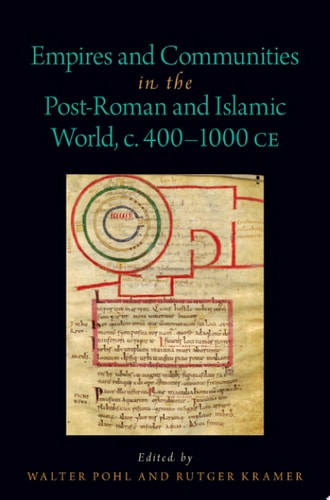
Empires and Communities in the Post-Roman and Islamic World, C. 400-1000 CE
0
0
As an Amazon Associate and affiliate partner, Menrva Books earns from qualifying purchases. Learn more
Author Description
This is an open access title available under the terms of a CC BY-NC 4.0 International licence. It is free to read at Oxford Scholarship Online and offered as a free PDF download from OUP and selected open access locations. This book deals with the ways empires affect smaller communities like ethnic groups, religious communities and local or peripheral populations. It raises the question how these different types of community were integrated into larger imperial edifices, and in which contexts the dialectic between empires and particular communities caused disruption. How did religious discourses or practices reinforce (or subvert) imperial pretenses? How were constructions of identity affected in the process? How were Egyptians accommodated under Islamic rule, Yemenis included in an Arab identity, Aquitanians integrated in the Carolingian empire, Jews in the Fatimid Caliphate? Why did the dissolution of Western Rome and the Abbasid Caliphate lead to different types of polities in their wake? How was the Byzantine Empire preserved in the 7th century; how did the Franks construct theirs in the 9th? How did single events in early medieval Rome and Constantinople promote social integration in both a local and a broader framework? Focusing on the post-Roman Mediterranean, this book deals with these questions from a comparative perspective. It takes into account political structures in the Latin West, in Byzantium and in the early Islamic world, and does so in a period that is exceptionally well suited to study the various expansive and erosive dynamics of empires, as well as their interaction with smaller communities. By never adhering to a single overall model, and avoiding Western notions of empire, this volume combines individual approaches with collaborative perspectives. Taken together, these chapters constitute a major contribution to the advancement of comparative studies on pre-modern empires.
Menrva's Summary
THE THESIS
This volume investigates the complex mechanisms through which pre-modern empires integrated or disrupted smaller ethnic, religious, and local communities between 400 and 1000 CE. The authors and contributors examine the dialectic between imperial structures and peripheral populations, questioning how religious practices and identity constructions functioned within the Latin West, Byzantium, and the Islamic world. By eschewing singular models of imperial governance, the work provides a comparative framework for understanding the expansive and erosive dynamics of power in the post-Roman Mediterranean.
THE SCOPE MAP
What You Will Find
- Comparative analysis of political structures in the Latin West, Byzantium, and the early Islamic world.
- Case studies on the integration of specific groups, including Egyptians under Islamic rule and Aquitanians in the Carolingian empire.
- Examination of how religious discourse reinforced or subverted imperial authority.
- Analysis of the divergent outcomes following the dissolution of Western Rome and the Abbasid Caliphate.
Scope Limits
- The study is geographically focused on the post-Roman Mediterranean and does not provide a global survey of all contemporary empires.
- The analysis is restricted to the period between 400 and 1000 CE.
THE AUTHORITY PERSPECTIVE
Experts recognize this volume as a significant contribution to comparative pre-modern history due to its rejection of Western-centric imperial models. Scholars frequently note that the text provides a rigorous, multi-disciplinary approach suitable for advanced students and researchers of early medieval political structures.
Page Count:
459
Publication Date:
2021-01-01
Publisher:
Oxford University Press
ISBN-10:
0190067969
ISBN-13:
9780190067960
History
Sociology
Social History
World
Egypt
Greece
European History
Comparative History
Italy
Middle Eastern
Community Tags
Similar Books