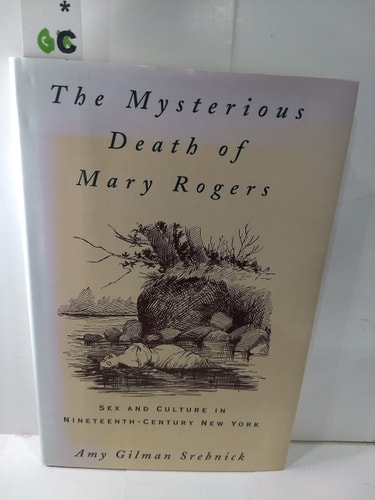
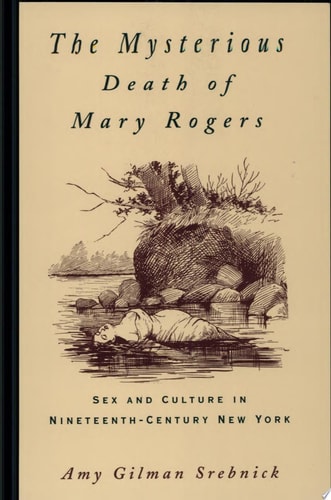
The Mysterious Death of Mary Rogers: Sex and Culture in Nineteenth-Century New York
0
0
As an Amazon Associate and affiliate partner, Menrva Books earns from qualifying purchases. Learn more
Author Description
In the summer of 1841, Mary Rogers disappeared without a trace from her New York City boarding house. Three days later, her body, badly bruised and waterlogged, was found floating in the shallow waters of the Hudson River just a few feet from the Jersey shore. Her story, parlayed into a long celebrated unsolved mystery, became grist for penny presses, social reformers, and politicians alike, and an impetus for popular literature, including Edgar Allen Poe's pioneering detective story "The Mystery of Marie Roget."In The Mysterious Death of Mary Rogers, historian Amy Gilman Srebnick brilliantly recaptures the story of Mary Rogers, showing how Rogers represented an emerging class of women who took advantage of the greater economic and sexual opportunities available to them in urban America, and how her death became a touchstone for the voicing of mid-nineteenth century concerns over sexual license, the changing roles of women, law and order, and abortion. Rogers' death, first thought due to a murderous gang of rapists and later tacitly understood to be the result of an ill-performed abortion, quickly became a source of popular entertainment, a topic of political debate, and an inspiration to public policy. The incident and the city's response to it provides a fascinating window into the urban culture and consciousness of the mid-1800s. Indeed, in Rogers' name, and as a direct result of her death, two important pieces of legislation were passed in 1845: the New York City Police Reform Act which effectively modernized the city's system of policing, and the New York State law criminalizing abortion.The Mysterious Death of Mary Rogers tells a story of a death, but more importantly it also tells the story of a life--that of Mary Rogers--and of the complex urban social world of which she was a part. Like the city in which she lived, Mary Rogers was a source of wonder, mystery, and fear, provoking desire, and inspiring narrative.
Menrva's Summary
THE THESIS
This book investigates the 1841 death of Mary Rogers to understand how a singular unsolved mystery functioned as a catalyst for shifting social, political, and legal norms in nineteenth-century New York. Historian Amy Gilman Srebnick utilizes primary source documents, including contemporary penny press accounts and legislative records, to reconstruct the life of a working-class woman navigating urban economic and sexual autonomy. The author argues that the public obsession with Rogers' death reflected deep-seated anxieties regarding female independence, the rise of urban crime, and the moral regulation of reproductive health. By situating the case within the broader context of the era, Srebnick demonstrates how the incident directly influenced the development of modern policing and the criminalization of abortion in New York.
THE SCOPE MAP
What You Will Find
- Analysis of the 1841 disappearance and death of Mary Rogers in New York City.
- Examination of the role of the penny press in shaping public perception and political discourse.
- Historical assessment of the New York City Police Reform Act of 1845 and its origins.
- Investigation into the cultural climate surrounding abortion and female sexuality in the mid-nineteenth century.
THE AUTHORITY PERSPECTIVE
Scholars and historians frequently cite this work as a foundational text for understanding the intersection of urban development, gender roles, and the evolution of American legal systems. Readers often note the academic rigor of the research, which successfully balances the narrative of a specific cold case with a broader sociological analysis of the period.
Page Count:
240
Publication Date:
1995-11-30
Publisher:
Oxford University Press
ISBN-10:
019506237X
ISBN-13:
9780195062373
True Crime
History
Nineteenth century
Social History
United States
American History
Sex Role
New York
Community Tags
Other Editions(2)
Similar Books









Reader Comments
Share Your Thoughts
No comments yet. Be the first to share your thoughts!