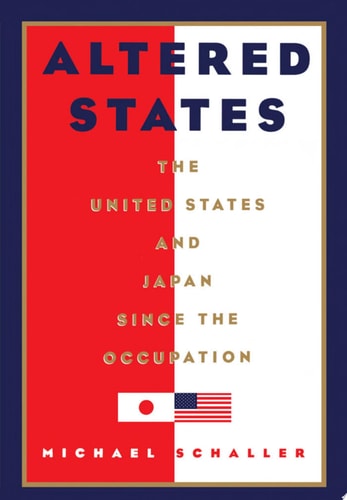
Altered States: The United States and Japan since the Occupation
0
0
As an Amazon Associate and affiliate partner, Menrva Books earns from qualifying purchases. Learn more
Author Description
The relationship between the United States and Japan is torn by contrary impulses. We face each other across the Pacific as friends and allies, as the two most powerful economies in the world--and as suspicious rivals. Americans admire the industry of the Japanese, but we resent the huge trade deficit that has developed between us, due to what we consider to be unfair trade practices and "unlevel playing fields." Now, in Altered States, historian Michael Schaller strips away the stereotypes and misinformation clouding American perceptions of Japan, providing the historical background that helps us make sense of this important relationship.Here is an eye-opening history of U.S.-Japan relations from the end of World War II to the present, revealing its rich depths and startling complexities. Perhaps Schaller's most startling revelation is that modern Japan is what we made it--that most of what we criticize in Japan's behavior today stems directly from U.S. policy in the 1950s. Indeed, as the book shows, for seven years after the end of the war, our occupational forces exerted enormous influence over the shape and direction of Japan's economic future. Stunned by the Communist victory in China and the outbreak of war in Korea, and fearful that Japan might form ties with Mao's China, the U.S. encouraged the rapid development of the Japanese economy, protecting the huge industrial conglomerates and creating new bureaucracies to direct growth. Thus Japan's government-guided, export-driven economy was nurtured by our own policy. Moreover, the United States fretted about Japan's economic weakness--that they would become dependent on us--and sought to expand Tokyo's access to markets in the very areas it had just tried to conquer, the old Co Prosperity Sphere. Schaller documents how, as the Cold War deepened throughout the 1950s, Washington showered money on what it saw as the keystone of the eastern shore of Asia, working assiduously to expand the Japanese economy and, in fa
Menrva's Summary
THE THESIS
How did United States policy during the post-World War II occupation fundamentally shape the modern economic and political structure of Japan? Michael Schaller, a historian specializing in American foreign policy, utilizes archival research and diplomatic records to argue that contemporary Japanese economic behavior is a direct byproduct of American strategic decisions made during the 1950s. He posits that U.S. fears regarding Communist expansion in Asia led Washington to actively nurture Japan's export-driven industrial model, effectively creating the very economic rivalries that later fueled bilateral tensions.
THE SCOPE MAP
What You Will Find
- Analysis of U.S. occupation policies from 1945 through the late 20th century.
- Examination of the Cold War geopolitical climate, specifically the impact of the Chinese Revolution and the Korean War.
- Documentation of the development of Japanese industrial conglomerates and government-led economic planning.
- Evaluation of trade relations and the evolution of the U.S.-Japan security alliance.
THE AUTHORITY PERSPECTIVE
Schaller's work is widely regarded as a critical text for understanding the historical roots of modern U.S.-Japan trade friction. Scholars frequently cite this book for its clear articulation of how Cold War security imperatives often undermined long-term economic stability between the two nations.
Page Count:
336
Publication Date:
1997-09-25
Publisher:
Oxford University Press
ISBN-10:
0195069161
ISBN-13:
9780195069167
History
Economics
United States
Cold War
Japan
International relations
Community Tags
Similar Books