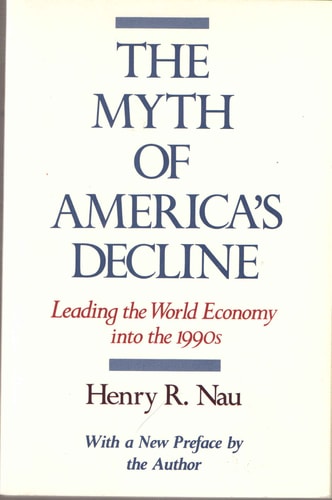
The Myth of America's Decline: Leading the World Economy into the 1990s
0
0
As an Amazon Associate and affiliate partner, Menrva Books earns from qualifying purchases. Learn more
Author Description
How can America be in decline and yet win the Cold War in 1989 and the Persian Gulf war in 1991? Because, as Henry R. Nau argues in this probing analysis of postwar policy, the Untied States, unlike the Soviet Union, shared power with its allies as it built a converging world community of political democracies and liberalized market. Today America leads that community as both the world's only military superpower and the one country Western governments trust to use military force for common objectives--a trust exemplified by the recent war in Kuwait.A loss of relative power, Nau contends, is not troublesome if it leads to more convergent domestic values and institutions among countries. Over a period of forty years, carefully chronicled in this book, the United States pursued political and economic policies that successfully nurtured Western democracies and integrated industrial economies. Through open markets, America helped allies catch up; and through open societies, the industrial nations overcame ethnic and economic divisions and grew to trust one another more. Although the United States lost relative economic power, it gained political friends and still remains, economically, the world's leader in absolute levels of productivity.Nor, according to the data assembled in this study, has the United States lost its ability to compete in foreign markets. The economic policies of the 1980s led to growth rates and manufacturing productivity increases that surpassed the boom years of American dominance from 1947-1967 and equaled or exceeded the performance of Germany and Japan in the latter part of the decade.The threat to our future, Nau contends, does not come from trade competition with the allies. It comes instead from domestic divisions that immobilize America's fiscal and domestic policies and prevent the country from taking the lead role in assisting the historic transformation underway in Eastern Europe, the Soviet Union, and many developing countries. Americans
Menrva's Summary
THE THESIS
Does the perceived decline of American global influence accurately reflect the nation's actual economic and political standing at the end of the twentieth century? Henry R. Nau, a scholar of international relations and foreign policy, challenges the declinist narrative prevalent in the early 1990s. He argues that the United States successfully fostered a global community of liberal democracies and market economies, maintaining absolute leadership in productivity despite a relative shift in power. Nau posits that the true threat to American prosperity is not foreign competition, but rather internal political paralysis regarding fiscal and domestic policy.
THE SCOPE MAP
What You Will Find
- A longitudinal analysis of United States foreign policy and economic performance from 1947 to the early 1990s.
- Comparative data sets evaluating manufacturing productivity and growth rates against Germany and Japan.
- An examination of the geopolitical impact of the Cold War conclusion and the Persian Gulf War.
- A framework for understanding how the integration of open markets and political alliances strengthens global stability.
THE AUTHORITY PERSPECTIVE
Experts recognize this work as a significant contribution to the debate on American hegemony during the post-Cold War transition. Readers frequently note the author's reliance on empirical economic data to counter popular political rhetoric of the era.
Page Count:
448
Publication Date:
1992-03-05
Publisher:
Oxford University Press
ISBN-10:
0195072723
ISBN-13:
9780195072723
Economics
History
Cold War
American Studies
United States
International relations
Community Tags
Other Editions(2)
Similar Books












Reader Comments
Share Your Thoughts
No comments yet. Be the first to share your thoughts!