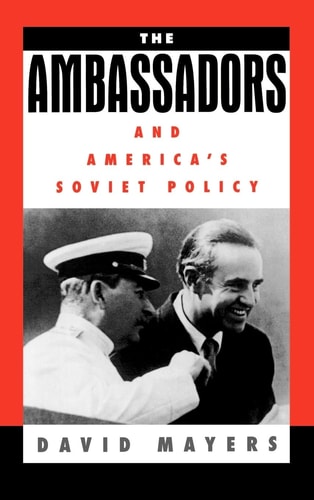
The Ambassadors and America's Soviet Policy
0
0
As an Amazon Associate and affiliate partner, Menrva Books earns from qualifying purchases. Learn more
Author Description
George Kennan, Charles Bohlen, W. Averell Harriman, William Bullitt, Joseph E. Davies, Llewlleyn Thompson, Jack Matlock: these are important names in the history of American foreign policy. Together with a number of lesser-known officials, these diplomats played a vital role in shaping U.S. strategy and popular attitudes toward the Soviet Union throughout its 75-year history. In The Ambassadors and America's Soviet Policy, David Mayers presents the most comprehensive critical examination yet of U.S. diplomats in the Soviet Union.Mayers' vivid portrayal evokes the social and intellectual atmosphere of the American embassy in the midst of crucial episodes: the Bolshevik Revolution, the Great Purges, the Grand Alliance in World War II, the early Cold War, the Cuban Missile Crisis, the rise and decline of detente, and the heady days of perestroika and glasnost. He also offers rare portraits of the professional lives of the diplomats themselves: their adjustment to Soviet life, the quality of their analytical reporting, their contact with other diplomats in Moscow, and their influence on Washington.Assessing the strengths and weaknesses of American diplomacy in its most challenging area, this compelling book fills an important gap in the history of U.S. foreign policy and U.S.-Soviet relations. Readers interested in U.S. foreign policy, the cold war, and the policies and history of the former Soviet Union will find The Ambassadors and America's Soviet Policy an intriguing and informative work.
Menrva's Summary
THE THESIS
This work investigates how individual American diplomats stationed in Moscow influenced the trajectory of U.S. foreign policy toward the Soviet Union across seven decades. David Allan Mayers, a scholar of international relations, utilizes archival records and biographical accounts to examine the professional contributions of key ambassadors. He argues that these figures were not merely observers but active participants who shaped Washington's strategic understanding of Soviet intentions and capabilities. The book provides a framework for evaluating the efficacy of diplomatic reporting during periods of both cooperation and intense geopolitical conflict.
THE SCOPE MAP
What You Will Find
- A chronological analysis of U.S.-Soviet relations from the Bolshevik Revolution through the era of perestroika.
- Biographical profiles of influential figures including George Kennan, Charles Bohlen, and W. Averell Harriman.
- An assessment of the professional environment and social constraints faced by American embassy staff in Moscow.
- A critical evaluation of the quality and impact of diplomatic cables and analytical reporting on U.S. policy decisions.
THE AUTHORITY PERSPECTIVE
Experts recognize this volume as a significant contribution to the study of diplomatic history, particularly for its focus on the human element within the U.S. foreign service. Readers frequently note the academic density of the prose, which serves as a foundational text for those studying the mechanics of Cold War diplomacy.
Page Count:
343
Publication Date:
1995-04-06
Publisher:
Oxford University Press
ISBN-10:
0195068025
ISBN-13:
9780195068023
Biography
History
International relations
Cold War
United States
Diplomacy
Community Tags
Similar Books