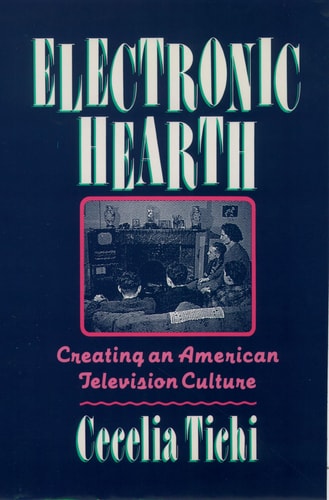
Electronic Hearth: Creating an American Television Culture
0
0
As an Amazon Associate and affiliate partner, Menrva Books earns from qualifying purchases. Learn more
Author Description
We all talk about the "tube" or "box," as if television were simply another appliance like the refrigerator or toaster oven. But Cecilia Tichi argues that TV is actually an environment--a pervasive screen-world that saturates almost every aspect of modern life. In Electronic Hearth, she looks at how that environment evolved, and how it, in turn, has shaped the American experience.Tichi explores almost fifty years of writing about television--in novels, cartoons, journalism, advertising, and critical books and articles--to define the role of television in the American consciousness. She examines early TV advertising to show how the industry tried to position the new device as not just a gadget but a prestigious new piece of furniture, a highly prized addition to the home. The television set, she writes, has emerged as a new electronic hearth--the center of family activity. John Updike described this "primitive appeal of the hearth" in Roger's Version: "Television is--its irresistible charm--a fire. Entering an empty room, we turn it on, and a talking face flares into being." Sitting in front of the TV, Americans exist in a safety zone, free from the hostility and violence of the outside world. She also discusses long-standing suspicions of TV viewing: its often solitary, almost autoerotic character, its supposed numbing of the minds and imagination of children, and assertions that watching television drugs the minds of Americans. Television has been seen as treacherous territory for public figures, from generals to presidents, where satire and broadcast journalism often deflate their authority. And the print culture of journalism and book publishing has waged a decades-long war of survival against it--only to see new TV generations embrace both the box and the book as a part of their cultural world. In today's culture, she writes, we have become "teleconscious"--seeing, for example, real life being certified through television ("as seen on TV"), and television consta
Menrva's Summary
THE THESIS
This book investigates how television transitioned from a mere household appliance to a pervasive cultural environment that fundamentally reshaped the American consciousness. Cecelia Tichi, a professor of English and American Studies, utilizes a vast archive of primary sources—including advertisements, literature, journalism, and cartoons—to construct her argument. She posits that television functions as an 'electronic hearth,' a central domestic anchor that simultaneously provides a sense of safety and serves as a site of intense cultural anxiety regarding its influence on the public mind.
THE SCOPE MAP
What You Will Find
- Analysis of fifty years of American media discourse, including novels, journalism, and advertising.
- Examination of the marketing strategies used to integrate television sets into the domestic sphere.
- Exploration of the tension between traditional print culture and the rise of broadcast media.
- Discussion of the psychological and social implications of 'teleconsciousness' in modern life.
THE AUTHORITY PERSPECTIVE
Experts in media studies frequently cite this work as a foundational text for understanding the cultural integration of television in the United States. Readers often note the academic rigor of the prose and the breadth of the historical evidence presented by the author.
Page Count:
272
Publication Date:
1992-10-29
Publisher:
Oxford University Press
ISBN-10:
0195079140
ISBN-13:
9780195079142
Social Aspects
Sociology
Technology and Society
Television broadcasting
Media Studies
American Studies
Cultural History
Community Tags
Similar Books