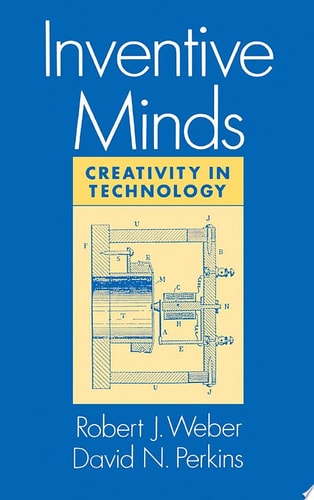
Inventive Minds: Creativity in Technology
0
0
As an Amazon Associate and affiliate partner, Menrva Books earns from qualifying purchases. Learn more
Author Description
Is invention really "99 percent" perspiration and "one percent inspiration" as Thomas Edison assured us? Inventive Minds assembles a group of authors well equipped to address this question: contemporary inventors of important new technologies, historians of science and industry, and cognitive psychologists interested in the process of creativity. In telling their stories, the inventors describe the origins of such remarkable devices as ultrasound, the electron microscope, and artificial diamonds. The historians help us look into the minds of innovators like Thomas Edison, Alexander Graham Bell, Michael Faraday, and the Wright brothers, drawing on original notebooks and other sources to show how they made their key discoveries. Finally, cognitive psychologists explore the mental processes that figure in creative thinking. Contributing to the authors' insight is their special focus on the "front end" of invention -- where ideas come from and how they are transformed into physical prototypes. They answer three questions: How does invention happen? How does invention contrast with other commonly creative pursuits such as scientific inquiry, musical composition, or painting? And how might invention best happen -- that is, what kinds of settings, conditions, and strategies appear to foster inventive activity? The book yields a wealth of information that will make absorbing reading for cognitive and social psychologists, social historians, and many working scientists and general readers who are interested in the psychology of personality and the roots of ingenuity.
Menrva's Summary
THE THESIS
This book investigates the cognitive and historical mechanisms of invention to determine whether creative breakthroughs are primarily the result of perspiration or inspiration. The authors, David N. Perkins and Robert J. Weber, curate a multidisciplinary analysis that integrates perspectives from contemporary inventors, historians of technology, and cognitive psychologists. By examining the "front end" of the inventive process, the text explores how abstract ideas transition into functional prototypes and the specific environmental conditions that facilitate such ingenuity.
THE SCOPE MAP
What You Will Find
- Historical case studies of innovators including Thomas Edison, Alexander Graham Bell, and the Wright brothers.
- Cognitive psychological frameworks explaining the mental processes behind creative thinking.
- Comparative analysis between invention and other creative fields like scientific inquiry and the arts.
- Practical insights into the settings and strategies that foster productive inventive activity.
THE AUTHORITY PERSPECTIVE
Experts and academics frequently cite this work as a foundational text for understanding the intersection of cognitive psychology and the history of technology. Readers often note the accessible yet rigorous nature of the prose, which balances technical psychological theory with engaging historical narratives.
Page Count:
368
Publication Date:
1992-11-26
Publisher:
Oxford University Press
ISBN-10:
0195071700
ISBN-13:
9780195071702
Psychology
Creative ability
Creativity
Inventions
Technology
Innovation