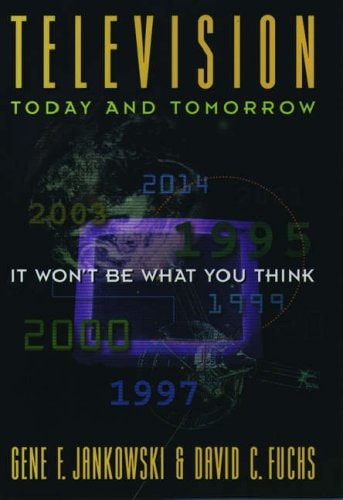
Television Today and Tomorrow: It Won't Be What You Think
0
0
As an Amazon Associate and affiliate partner, Menrva Books earns from qualifying purchases. Learn more
Author Description
In recent years, the media has been awash in exuberant tales of the arrival of the information superhighway, when television will explode with exciting possibilities, offering some 500 channels as well as a marriage of TV and computer that will provide, on command, access to the latest movies, magazines, newspapers, books, sports events, stock exchange figures, your bank account, and much, much more. And the major TV networks, pundits add, will be doomed to extinction by this revolution in cable, computers, and fiber optics. But in Television Today and Tomorrow, Gene Jankowski--former President and Chairman of the CBS Broadcast Group--and David Fuchs--also a former top executive at CBS--tell a different story. They predict a bumpy road ahead for the information superhighway, and the major networks, they say, are abundantly healthy and will remain so well into the next century.The information superhighway, Jankowski and Fuchs admit, will dramatically increase the distribution channels, but it will have little impact on the amount of programming created--and this may spell disaster. The authors show how the networks began as a way to provide programs to local stations (who could not afford to produce their own), who in turn provided the distribution that gave networks access to mass audiences and ultimately large advertising dollars. They then offer us an inside look at television production--showing us, for instance, a veteran scriptwriter putting together a breakfast table scene for "Cloud Nine"--to underscore how much effort goes into producing just two minutes of primetime programming. They reveal that the present 20 channels require some 20,000 hours of programming each year, which is more than all the Broadway plays produced in this century, and they conclude that without a dramatic increase in programming (which won't happen if only because of the very finite supply of talent), the superhighway will be jammed bumper-to-bumper with reruns, old movies, and inexpensive filler.
Menrva's Summary
THE THESIS
This book investigates the viability of the information superhighway and the future of major television networks in the face of rapid technological expansion. Drawing on their extensive executive experience at CBS, Gene F. Jankowski and David C. Fuchs challenge the prevailing narrative that cable, computers, and fiber optics will render traditional networks obsolete. They argue that while distribution channels will multiply, the finite supply of creative talent will prevent a corresponding increase in quality programming, thereby ensuring the continued dominance of established networks.
THE SCOPE MAP
What You Will Find
- Analysis of the economic and structural history of network television.
- Examination of the production constraints and labor requirements for primetime content.
- Critique of the information superhighway model and its reliance on increased distribution.
- Projections regarding the sustainability of mass-audience broadcasting in a fragmented media landscape.
THE AUTHORITY PERSPECTIVE
Experts view this work as a significant counter-narrative to the technological optimism prevalent during the mid-1990s media landscape. Readers often note the authors' unique insider perspective, which provides a pragmatic look at the logistical realities of television production.
Page Count:
256
Publication Date:
1995-05-25
Publisher:
Oxford University Press
ISBN-10:
0195074874
ISBN-13:
9780195074871
Business
Communication
Technology
Media Studies
Television broadcasting
Television
Community Tags
Similar Books





Reader Comments
Share Your Thoughts
No comments yet. Be the first to share your thoughts!