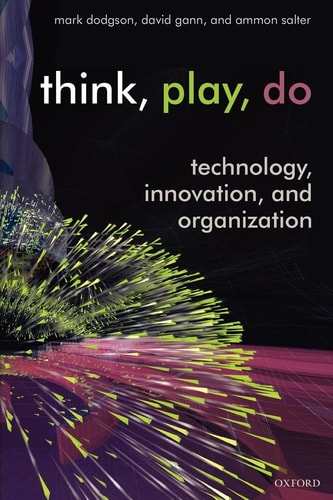
Think, Play, Do: Innovation, Technology, and Organization
0
0
As an Amazon Associate and affiliate partner, Menrva Books earns from qualifying purchases. Learn more
Author Description
The innovation process is the most important of all business processes. Innovation is the means by which value is constructed and efficiencies are created. It is the source of sustainable competitive advantage. This book shows how the innovation process is changing profoundly. Part of the change results from the application of new technologies to the innovation process itself. A new category of technology has emerged which we call 'innovation technology'. This includes simulation and modeling, visualization and economical and ameliorates some of its uncertainties. These technological changes are accompanied by changing organization structures and skills requirements. The technologies are used in fast moving, creative environments and are suite to project-based organization. They also require the development of new 'craft' skills to realize the possibilities created by the new 'code'. The book outlines a new way of thinking about innovation. Traditional definitions of 'research', 'development' and 'engineering', imply a progressive linearity which doesn't exist in reality. They are also associated with organizational departments, which are breaking down where once they existed, and are in any case non-existent in the vast majority of firms. They also fail to capture the central importance of design in innovation. We propose a new schema for the innovation process: Think, Play, Do. Innovation requires creating new ideas and thinking about new options, playing with them to see if they are practical, economical and marketable, and then doing: making the innovation real. This new schema captures the emerging innovation process using a more contemporary idiom. The book reports in-depth studies from a number of companies and sectors. Major case studies of Proctor and Gamble and Arup Partners are presented. It reports on the use of innovation technology in a range of other companies and organizations, from pharmaceuticals in GSK, to engineering design in Ricardo engineering, and welding in TWI. We describe how innovation technology is used in traditional industries, such as in mining, and in public projects, such as the development of London's traffic congestion charge and the stabilization of the leaning tower of Pisa.
Menrva's Summary
THE THESIS
This book investigates how the traditional, linear models of research and development are being replaced by a dynamic, technology-driven process of innovation. The authors, Ammon Salter, David Gann, and Mark Dodgson, leverage their expertise in organizational management and technology to argue that modern innovation requires a shift in both organizational structure and skill sets. They introduce the 'Think, Play, Do' framework to replace outdated, department-centric models, emphasizing the integration of simulation, visualization, and design as core components of value creation.
THE SCOPE MAP
What You Will Find
- A comprehensive analysis of 'innovation technology' including simulation, modeling, and visualization tools.
- The 'Think, Play, Do' framework as a contemporary alternative to linear R&D processes.
- In-depth case studies of organizations such as Proctor and Gamble, Arup Partners, GSK, and Ricardo Engineering.
- Examination of how project-based organizational structures and new 'craft' skills facilitate innovation.
THE AUTHORITY PERSPECTIVE
Experts and business scholars recognize this work as a significant contribution to the study of modern innovation management. Readers frequently note the practical application of the case studies, which help bridge the gap between theoretical organizational shifts and real-world corporate implementation.
Page Count:
280
Publication Date:
2005-09-15
Publisher:
Oxford University Press
ISBN-10:
0199268096
ISBN-13:
9780199268092
Business
Technology
Innovation
Design
Management
Organization
Community Tags
Other Editions(2)
Similar Books









Reader Comments
Share Your Thoughts
No comments yet. Be the first to share your thoughts!