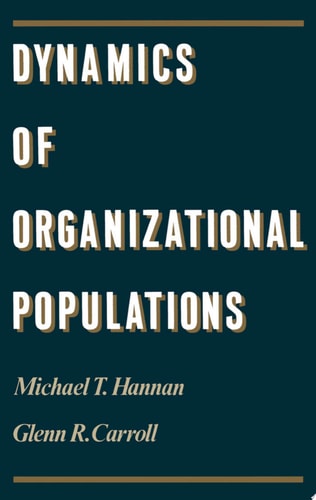
Dynamics of Organizational Populations: Density, Legitimation, and Competition
0
0
As an Amazon Associate and affiliate partner, Menrva Books earns from qualifying purchases. Learn more
Author Description
Why does the number of organizations of any given kind vary over time? Utilizing a diverse group of organizations including national labor unions, newspapers and newspaper publishers, brewing firms, life insurance companies, and banks, this book seeks to deepen and broaden the understanding of change in organizational populations by examining the dynamics of numbers of organizations in populations. Such an approach involves explaining the sources of growth and decline in the sum of organizations (what the authors call "density") over the histories of populations of organizations. The authors conclude their study by formulating a theory of density-dependent legitimation and competition.
Menrva's Summary
THE THESIS
This work investigates the fundamental mechanisms that drive the growth and decline of organizational populations over time. Authors Glenn R. Carroll and Michael T. Hannan utilize extensive historical data to construct a formal theory of density-dependent legitimation and competition. By analyzing diverse sectors such as labor unions, newspapers, and banking, they provide a rigorous framework for understanding how environmental factors and internal population dynamics dictate the survival and proliferation of organizational forms.
THE SCOPE MAP
What You Will Find
- Longitudinal analysis of organizational populations including labor unions, newspapers, and life insurance firms
- Theoretical framework for density-dependent legitimation and competition
- Quantitative modeling of organizational birth and death rates
- Examination of environmental constraints on organizational growth
THE AUTHORITY PERSPECTIVE
Experts recognize this text as a foundational contribution to organizational ecology and institutional theory. Readers frequently note the academic density of the prose, which is intended for scholars and advanced students of organizational behavior.
Page Count:
304
Publication Date:
1992-01-02
Publisher:
Oxford University Press
ISBN-10:
0195071913
ISBN-13:
9780195071917
Economics
Business
Sociology
Organizational change
Management
Organizational Theory
Community Tags
Similar Books