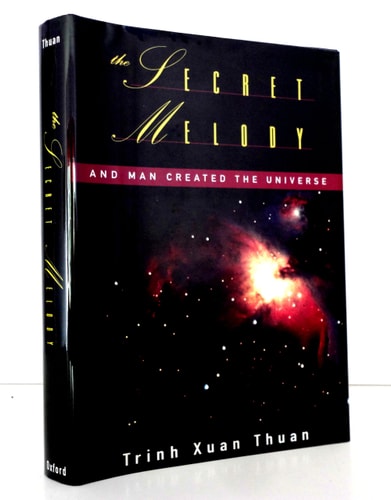
The Secret Melody: And Man Created the Universe
0
0
As an Amazon Associate and affiliate partner, Menrva Books earns from qualifying purchases. Learn more
Author Description
If the cosmos is vast, says astrophysicist Trinh Xuan Thuan, it is by no means silent. Nature, he writes, "delights in continuously sending us her notes of music." Like some far-off orchestra, it tantalizes us with fragments of a symphony, but the melody linking the bits and snatches of song is missing. The task of science is to unravel the secrets of that hidden melody, so that we can listen to the composition in all its glory.In The Secret Melody, Trinh Xuan Thuan examines our many attempts to capture the music of nature and hear the cosmic fugue. First, as prelude, he describes the many other cosmologies that preceded the modern Big Bang theory of creation--the magical universe of cavemen, the ancient Chinese idea of the universe (which Thuan compares to a gigantic bureaucracy), the mathematical universe introduced by Pythagoras, and the heliocentric universe of Copernicus--and he explores the work of Galileo, Tycho Brahe, and other early scientists. He then describes in a clear, vivid, and poetic language our current understanding of the cosmos, painting a sharp picture of how modern astronomers study the universe, the equipment they use, the most prominent scientists, and the major discoveries. A mind-boggling portrait of the cosmos emerges in these pages. We read, for instance, of the incredible size of our own galaxy, the Milky Way, which is some 90,000 light-years in diameter, with several hundred billion stars orbiting its center. More amazing, we discover we live in a universe where stars, like human beings, are born, live, and die, leaving behind such strange and exotic objects as neutron stars and black holes; where time may expand and space may contract; and where billions of galaxies have sprung from a tiny primordial speck that was infinitely smaller than a hydrogen atom in a gigantic explosion, the Big Bang. And, of course, any examination of the origin and nature of the universe inevitably raises philosophical and religious questions, and Thuan exam
Menrva's Summary
THE THESIS
How does the human endeavor to understand the cosmos reflect our search for a unifying, harmonious structure within the physical laws of the universe? Trinh Xuan Thuan, a distinguished astrophysicist, utilizes his expertise to bridge the gap between complex astronomical data and philosophical inquiry. By synthesizing the history of human cosmology with modern scientific breakthroughs, he argues that the universe operates according to an underlying, elegant order that science is only beginning to decipher.
THE SCOPE MAP
What You Will Find
- A historical survey of cosmological models ranging from ancient mythologies to the Copernican revolution.
- Detailed explanations of modern astrophysical phenomena, including stellar evolution, black holes, and the Big Bang theory.
- An examination of the intersection between scientific discovery and philosophical or religious interpretation.
- Descriptions of the technological tools and observational methods employed by contemporary astronomers to map the galaxy.
THE AUTHORITY PERSPECTIVE
Experts and readers alike praise this work for its ability to translate dense astrophysical concepts into accessible, poetic prose. It is frequently cited as a foundational text for those seeking to understand the historical and philosophical context of modern cosmology.
Page Count:
336
Publication Date:
1995-06-15
Publisher:
Oxford University Press
ISBN-10:
0195073703
ISBN-13:
9780195073706
Science
SCIENCE Astronomy
Astronomy
Philosophy history
Cosmology
Astrophysics
Community Tags
Similar Books