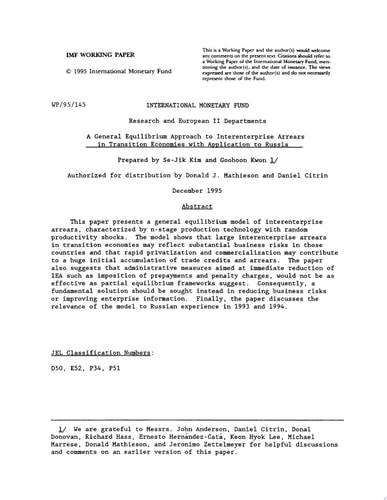
A General Equilibrium Approach to Interenterprise Arrears in Transition Economies with Application to Russia
0
0
As an Amazon Associate and affiliate partner, Menrva Books earns from qualifying purchases. Learn more
Author Description
This paper presents a general equilibrium model of interenterprise arrears, characterized by n-stage production technology with random productivity shocks. The model shows that large interenterprise arrears in transition economies may reflect substantial business risks in those countries and that rapid privatization and commercialization may contribute to a huge initial accumulation of trade credits and arrears. The paper also suggests that administrative measures aimed at immediate reduction of IEA such as imposition of prepayments and penalty charges, would not be as effective as partial equilibrium frameworks suggest. Consequently, a fundamental solution should be sought instead in reducing business risks or improving enterprise information. Finally, the paper discusses the relevance of the model to Russian experience in 1993 and 1994.
Menrva's Summary
THE THESIS
This paper investigates the causes and implications of interenterprise arrears in transition economies, using a general equilibrium model. The authors, Goohoon Kwon and Mr. Se-Jik Kim, develop a model featuring n-stage production with random productivity shocks to analyze the accumulation of arrears. They argue that large arrears can be a symptom of substantial business risks inherent in these economies and that rapid privatization can initially exacerbate trade credit and arrears. The paper posits that administrative measures like prepayments and penalties are less effective than suggested by partial equilibrium analyses, advocating instead for solutions that reduce business risks or improve enterprise information.
THE SCOPE MAP
- A general equilibrium model of interenterprise arrears with n-stage production and random productivity shocks.
- Analysis of how business risks in transition economies contribute to interenterprise arrears.
- Discussion on the role of rapid privatization and commercialization in the initial accumulation of trade credits and arrears.
- Evaluation of the effectiveness of administrative measures (prepayments, penalty charges) for reducing arrears.
- Suggestions for fundamental solutions focused on reducing business risks and improving enterprise information.
- Application of the model to the specific experiences of Russia in 1993 and 1994.
THE AUTHORITY PERSPECTIVE
This paper offers a rigorous economic modeling approach to understanding a critical issue in transition economies. The authors' general equilibrium framework provides a nuanced perspective on the origins and persistence of interenterprise arrears, moving beyond simpler partial equilibrium explanations. By linking arrears to underlying business risks and the dynamics of privatization, the study offers insights into the challenges faced by economies in transition. The application to the Russian context grounds the theoretical findings in a real-world case study, suggesting the model's practical relevance.
Page Count:
30
Publication Date:
1995-12-01
Publisher:
International Monetary Fund
ISBN-10:
1451856490
ISBN-13:
9781451856491
Business
Non-Fiction
Economics
Economic History
Community Tags
Similar Books