The First Industrial Woman
0
0
As an Amazon Associate and affiliate partner, Menrva Books earns from qualifying purchases. Learn more
Author Description
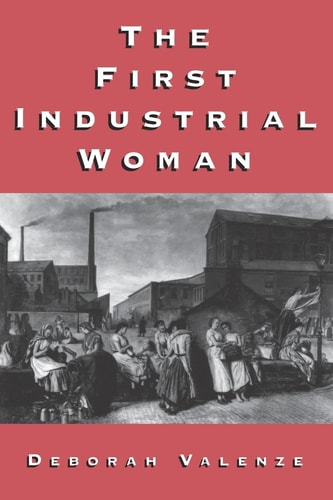
Why study women and the industrial revolution? Deborah Valenze's groundbreaking reassessment of this classic problem in European history reminds us that questions of gender and work are at the center of our experience in the modern world.Too often, the study of industrialization charts an inevitable and largely technological course. Valenze sets aside this approach in order to examine the underlying assumptions about gender and work that informed the transformation of English society, and in turn, our ideas about economic progress. How did England change from an agriculturally based nation, in which female labor played an active and acknowledged part, to an industrial power resting on a notion of male productivity? Through selective treatments of agriculture, spinning, and cottage industries, Valenze shows how the rise of values of productivity and rationality subordinated women of the working class and strengthened an emerging ethos of individualism. She also analyzes the influential ideas of Thomas Malthus, Hannah More, and other authors, whose publications reinforced these same tendencies in the early nineteenth century. In an elegant and compelling account, Valenze charts the birth of a new economic order resting on social and sexual hierarchies which remain a part of our contemporary lives.
Menrva's Summary
THE THESIS
How did the transition to an industrial economy in England fundamentally reshape societal perceptions of gender, labor, and economic productivity? Deborah Valenze, a historian specializing in European social and economic history, challenges the traditional technological focus of industrialization narratives. She argues that the shift toward industrial capitalism was not merely a mechanical evolution but a social restructuring that marginalized female labor and codified new, restrictive gender hierarchies.
THE SCOPE MAP
What You Will Find
- Analysis of the transition from agrarian-based female labor to industrial male-centric productivity models.
- Examination of the influence of nineteenth-century thinkers such as Thomas Malthus and Hannah More on economic ideology.
- Case studies focusing on the evolution of agriculture, spinning, and cottage industries.
- A critique of how individualism and rationality were used to justify the subordination of working-class women.
THE AUTHORITY PERSPECTIVE
Historians and scholars of gender studies frequently cite this work as a foundational text for understanding the intersection of economic progress and social inequality. Readers often note the academic rigor of the prose, which effectively links historical economic shifts to the persistence of contemporary sexual hierarchies.
Page Count:
272
Publication Date:
1995-03-30
Publisher:
Oxford University Press
ISBN-10:
0195089820
ISBN-13:
9780195089820
History
Social History
Gender Studies
Economic History
Women
Community Tags
Similar Books