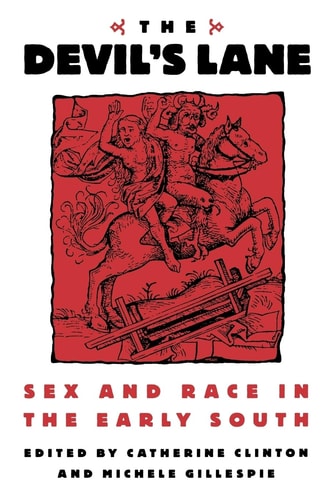
The Devil's Lane: Sex and Race in the Early South
0
0
As an Amazon Associate and affiliate partner, Menrva Books earns from qualifying purchases. Learn more
Author Description
When Europeans settled in the early South, they quarreled over many things--but few imbroglios were so fierce as battles over land. Landowners wrangled bitterly over boundaries with neighbors and contested areas became known as "the devil's lane." Violence and bloodshed were but some of the consequences to befall those who ventured into these disputed territories.The Devil's Lane highlights important new work on sexuality, race, and gender in the South from the seventeenth- to the nineteenth-centuries. Contributors explore legal history by examining race, crime and punishment, sex across the color line, and slander. Emerging stars and established scholars such as Peter Wood and Carol Berkin weave together the fascinating story of competing agendas and clashing cultures on the southern frontier. One chapter focuses on a community's resistance to a hermaphrodite, where the town court conducted a series of "examinations" to determine the individual's gender. Other pieces address topics ranging from resistance to sexual exploitation on the part of slave women to spousal murders, from interpreting women's expressions of religious ecstasy to a pastor's sermons about depraved sinners and graphic depictions of carnage, all in the name of "exposing" evil, and from a case of infanticide to the practice of state-mandated castration.Several of the authors pay close attention to the social and personal dynamics of interracial women's networks and relationships across place and time. The Devil's Lane illuminates early forms of sexual oppression, inviting comparative questions about authority and violence, social attitudes and sexual tensions, the impact of slavery as well as the twisted course of race relations among blacks, whites, and Indians. Several scholars look particularly at the Gulf South, myopically neglected in traditional literature, and an outstanding feature of this collection.These eighteen original essays reveal why the intersection of sex and race marks an essent
Menrva's Summary
THE THESIS
This collection investigates how the intersections of race, gender, and sexuality shaped the social and legal landscape of the early American South. Editors Catherine Clinton and Michele Gillespie compile original essays from established and emerging scholars to analyze how power dynamics, violence, and cultural clashes defined life on the southern frontier from the seventeenth to the nineteenth centuries. By examining primary legal records and social histories, the contributors argue that these intimate and public conflicts were foundational to the development of the region's racial and sexual hierarchies.
THE SCOPE MAP
What You Will Find
- Analysis of legal history regarding race, crime, punishment, and slander.
- Examination of interracial relationships and women's social networks across the Gulf South.
- Case studies on topics including infanticide, sexual exploitation, religious ecstasy, and state-mandated castration.
- Exploration of the cultural and social tensions between black, white, and indigenous populations.
THE AUTHORITY PERSPECTIVE
Scholars and historians frequently cite this work for its focus on the Gulf South, a region often overlooked in traditional historical narratives. The text is recognized for its rigorous use of primary source material to illuminate the complex and often violent social structures of the early American frontier.
Page Count:
304
Publication Date:
1997-06-26
Publisher:
Oxford University Press
ISBN-10:
0195112431
ISBN-13:
9780195112436
History
Race Relations
Southern History
Sex Role
Southern States
Gender Studies
Women
Legal History
Social History
Community Tags
Similar Books