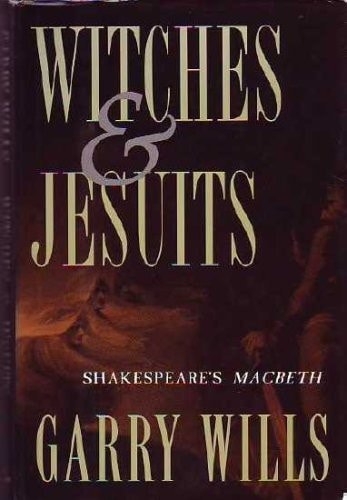
Witches and Jesuits: Shakespeare's Macbeth
0
0
As an Amazon Associate and affiliate partner, Menrva Books earns from qualifying purchases. Learn more
Author Description
In his Pulitzer prize-winning 1993 book Lincoln at Gettysburg, Garry Wills showed how the Gettysburg Address revolutionized the conception of modern America. In Witches and Jesuits, Wills again focuses on a single document to open up a window on an entire society. He begins with a simple question: If Macbeth is such a great tragedy, why do performances of it so often fail? After all, the stage history of Macbeth is so riddled with disasters that it has created a legendary curse on the drama. Superstitious actors try to evade the curse by referring to Macbeth only as "the Scottish play," but production after production continues to soar in its opening scenes, only to sputter towards anticlimax in the later acts. By critical consensus there seems to have been only one entirely successful modern performance of the play, Laurence Olivier's in 1955, and even Olivier twisted his ankle on opening night. But Olivier's ankle notwithstanding, Wills maintains that the fault lies not in Shakespeare's play, but in our selves.Drawing on his intimate knowledge of the vivid intrigue and drama of Jacobean England, Wills restores Macbeth's suspenseful tension by returning it to the context of its own time, recreating the burning theological and political crises of Shakespeare's era. He reveals how deeply Macbeth's original 1606 audiences would have been affected by the notorious Gunpowder Plot of 1605, when a small cell of Jesuits came within a hairbreadth of successfully blowing up not only the King, but the Prince his heir, and all members of the court and Parliament. Wills likens their shock to that endured by Americans following Pearl Harbor or the Kennedy assassination. Furthermore, Wills documents, the Jesuits were widely believed to be acting in the service of the Devil, and so pervasive was the fear of witches that just two years before Macbeth's first performance, King James I added to the witchcraft laws a decree of death for those who procured "the skin, bone, or any other
Menrva's Summary
THE THESIS
Garry Wills investigates why modern stage productions of Macbeth frequently fail to maintain their momentum, arguing that the play's intended impact is lost when divorced from the specific political and theological anxieties of its original Jacobean audience. Wills, a renowned historian and cultural critic, utilizes his deep knowledge of early 17th-century England to reframe the play not as a timeless abstraction, but as a direct response to the trauma of the Gunpowder Plot. By examining the intersection of Jesuit intrigue, witchcraft legislation, and royal paranoia, he posits that the play's structural "anticlimax" is actually a misunderstanding of the intense, immediate fears that defined the 1606 theatrical experience.
THE SCOPE MAP
What You Will Find
- Historical analysis of the 1605 Gunpowder Plot and its impact on the Jacobean psyche.
- Examination of King James I's legislative efforts regarding witchcraft and religious dissent.
- Comparative study of the play's stage history and the recurring "curse" of Macbeth.
- Contextual framework for understanding the religious tensions between Jesuits and the English state.
THE AUTHORITY PERSPECTIVE
Scholars and critics frequently cite this work as a vital intervention in Shakespearean studies, noting how it successfully bridges the gap between historical research and theatrical performance. Readers often highlight the clarity of Wills's prose, which makes complex political history accessible to both academics and general theater enthusiasts.
Page Count:
240
Publication Date:
1995-01-05
Publisher:
Oxford University Press
ISBN-10:
0195088794
ISBN-13:
9780195088793
Drama
History
Literary Criticism
Tragedy
Theology
Shakespeare
Community Tags
Similar Books