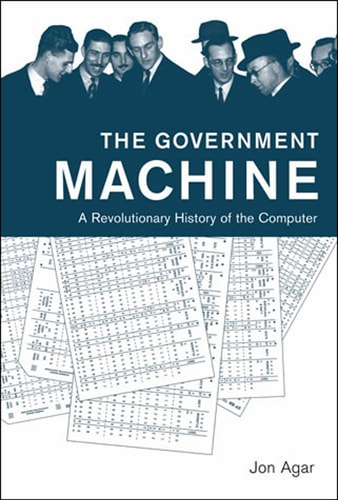
The Government Machine: A Revolutionary History of the Computer
0
0
As an Amazon Associate and affiliate partner, Menrva Books earns from qualifying purchases. Learn more
Author Description
An examination of technology and politics in the evolution of the British "government machine." In The Government Machine, Jon Agar traces the mechanization of government work in the United Kingdom from the nineteenth to the early twenty-first century. He argues that this transformation has been tied to the rise of "expert movements," groups whose authority has rested on their expertise. The deployment of machines was an attempt to gain control over state action—a revolutionary move. Agar shows how mechanization followed the popular depiction of government as machine-like, with British civil servants cast as components of a general purpose "government machine"; indeed, he argues that today's general purpose computer is the apotheosis of the civil servant. Over the course of two centuries, government has become the major repository and user of information; the Civil Service itself can be seen as an information-processing entity. Agar argues that the changing capacities of government have depended on the implementation of new technologies, and that the adoption of new technologies has depended on a vision of government and a fundamental model of organization. Thus, to study the history of technology is to study the state, and vice versa.
Menrva's Summary
THE THESIS
The deployment of machines in government was a revolutionary attempt to gain control over state action. Jon Agar examines the mechanization of government work in the United Kingdom from the nineteenth to the early twenty-first century, arguing that this transformation is intrinsically linked to the rise of
THE SCOPE MAP
- The evolution of government technology in the UK from the 19th to the 21st century.
- The role of
THE AUTHORITY PERSPECTIVE
The book is regarded as a significant contribution to the history of technology and politics, particularly within the British context. It offers a novel perspective on how the increasing mechanization of government functions has shaped state power and the concept of expertise. The argument that the modern computer represents the apotheosis of the civil servant provides a compelling framework for understanding the information-processing nature of the state. This work is likely to be of interest to scholars of history, political science, and the sociology of technology.
Page Count:
564
Publication Date:
2016-12-16
Publisher:
MIT Press
ISBN-10:
026253388X
ISBN-13:
9780262533881
Non-Fiction
History
Politics
Technology
Information Science
Community Tags
Similar Books