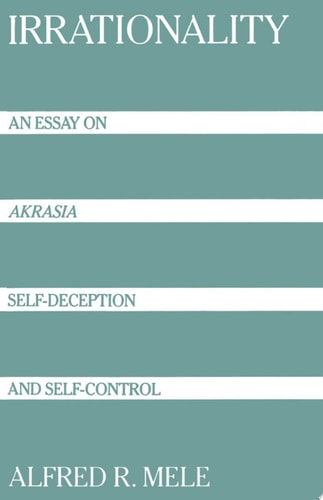
Irrationality: An Essay on Akrasia, Self-Deception, and Self-Control
0
0
As an Amazon Associate and affiliate partner, Menrva Books earns from qualifying purchases. Learn more
Author Description
Although much human action serves as proof that irrational behavior is remarkably common, certain forms of irrationality--most notably, incontinent action and self-deception--pose such difficult theoretical problems that philosophers have rejected them as logically or psychologically impossible. Here, Mele shows that, and how, incontinent action and self-deception are indeed possible. Drawing upon recent experimental work in the psychology of action and inference, he advances naturalized explanations of akratic action and self-deception while resolving the paradoxes around which the philosophical literature revolves. In addition, he defends an account of self-control, argues that "strict" akratic action is an insurmountable obstacle for traditional belief-desire models of action-explanation, and explains how a considerably modified model accommodates action of this sort.
Menrva's Summary
THE THESIS
This book investigates the theoretical possibility and psychological mechanisms behind akrasia, or incontinent action, and self-deception. Alfred R. Mele, a prominent philosopher of action, utilizes a combination of conceptual analysis and empirical findings from cognitive psychology to challenge the traditional philosophical view that such behaviors are impossible. He proposes a naturalized framework that reconciles these irrational actions with a modified belief-desire model of human agency.
THE SCOPE MAP
What You Will Find
- Analysis of the paradoxes surrounding incontinent action and self-deception.
- Integration of experimental psychological data into philosophical action theory.
- A defense of a specific model of self-control and human agency.
- Critique of traditional belief-desire models in the context of strict akratic action.
THE AUTHORITY PERSPECTIVE
Experts recognize this work as a significant contribution to the philosophy of action, particularly for its successful bridge between conceptual analysis and empirical psychology. Readers frequently note the academic density of the prose, which is intended for those with a background in philosophical inquiry or cognitive science.
Page Count:
200
Publication Date:
1987-01-01
Publisher:
Oxford University Press
ISBN-10:
0195080017
ISBN-13:
9780195080018
Philosophy
Non-Fiction
Psychology
Act Philosophy
Self-control
Ethics
Self-deception
Community Tags
Other Editions(3)

Similar Books