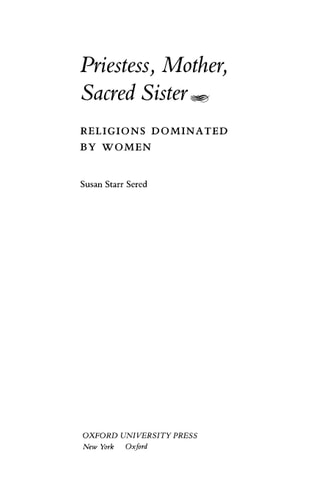
Priestess, Mother, Sacred Sister: Religions Dominated by Women
0
0
As an Amazon Associate and affiliate partner, Menrva Books earns from qualifying purchases. Learn more
Author Description
In this fascinating and pathbreaking work, Susan Starr Sered uncovers, describes, and analyzes religions, scattered throughout the world, in which women are both the majority of leaders and the majority of participants. How are these women's religions different from those dominated by men? What can we learn from them about the ways in which women experience and interpret the supernatural? How do women construct religion? Looking for common threads linking groups as diverse as the Sande secret societies of West Africa, matrilineal spirit cults of northern Thailand, Christian Science, and the Feminist Spirituality movement, Sered asks whether there is anything particularly "womanly" about women's religions. She finds that women's concerns and identity as mothers play a vital role in these female-dominated groups. Nurturing and concern for others are at the center, as are healing arts and ways of dealing with illness and the death of children. Religion not only enables women to find sacred meaning in their daily lives, from the preparation of food to caring for their families, but can offer intense and personal relationships with deities and spirits - often through ecstatic possession trance. These religions provide women with opportunities to celebrate and mourn with other women, as well as forums for advancing women's social and economic rights and security. In all of these religions, women priestesses, shamans or ritual experts embody the spiritual power available to women. By examining the shared experiences of women across great cultural divides, Priestess, Mother, Sacred Sister offers a new understanding of the role gender plays in determining how individuals grapple with the ultimate questions of existence. In the process, it not only highlights the profound differences between men and women, but the equally important ways in which we are all alike.
Menrva's Summary
THE THESIS
How do religious systems dominated by women differ from those led by men, and what do these structures reveal about the intersection of gender, motherhood, and the supernatural? Susan S. Sered, an anthropologist, utilizes cross-cultural comparative analysis to examine diverse religious groups where women hold the majority of leadership and participant roles. She argues that these religions are fundamentally shaped by women's experiences, particularly their roles as mothers and caregivers, which influence how they construct sacred meaning and interact with the divine.
THE SCOPE MAP
What You Will Find
- Comparative analysis of diverse groups including the Sande secret societies, Thai spirit cults, Christian Science, and Feminist Spirituality.
- Examination of the role of healing arts and maternal concerns in religious practice.
- Analysis of ecstatic possession trance as a mechanism for personal relationships with deities.
- Discussion of how religious participation facilitates social and economic security for women.
THE AUTHORITY PERSPECTIVE
Scholars and readers recognize this work as a significant contribution to the anthropology of religion for its focus on female-centered spiritual structures. Experts frequently cite the text for its ability to synthesize disparate cultural practices into a coherent framework regarding gender and religious authority.
Page Count:
352
Publication Date:
1994-05-19
Publisher:
Oxford University Press
ISBN-10:
0195083954
ISBN-13:
9780195083958
Religion
Gender Studies
Anthropology
Sociology
Religious Life
Community Tags
Similar Books