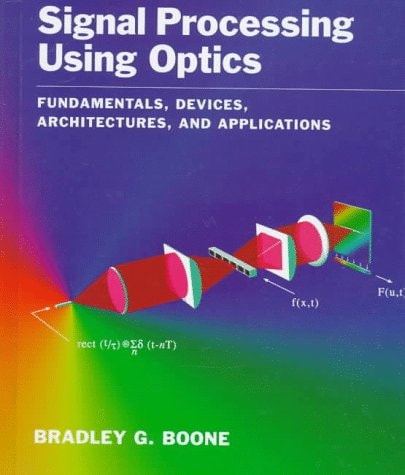
Signal Processing Using Optics: Fundamentals, Devices, Architectures, and Applications
0
0
As an Amazon Associate and affiliate partner, Menrva Books earns from qualifying purchases. Learn more
Author Description
Signal Processing Using Optics covers the fundamental aspects of optical signal processing at an introductory level and also discusses more applied topics, helping students and professionals bridge the gap to the current technical literature. Although readers are expected to have previous knowledge of one-dimensional signals and systems and optics beyond general physics, this self-contained text reviews the essentials of signal processing, optics, and imaging to make necessary background information readily available. It continues on with coverage of devices, architectures, and prominent applications, providing students with insight into the mathematical and physical principles, a practical understanding of component technology and performance, a grasp of system design and analysis, and a familiarity with architectures for selected but representative applications. Ideal for senior-level undergraduate and first year graduate students in electrical engineering and applied physics as well as practicing engineers and scientists, this accessible text also includes problem exercises, selected hints and solutions, extensive references, and MATLAB-based modeling (available via the World Wide Web at http://www.jhuapl.edu/public/books/OSPbook/firstpage.html). It also offers simulation tools to support students exploration of applications and to direct their learning towards the current technical literature. Numerous architectural diagrams are provided to help students understand and visualize important concepts and their implementation.
Menrva's Summary
THE THESIS
This text investigates the fundamental principles and practical implementation of optical signal processing systems. Author Bradley G. Boone, drawing from his expertise at the Applied Physics Laboratory, provides a structured framework that connects theoretical optics with real-world engineering applications. The book serves as a bridge for students and professionals, synthesizing mathematical modeling with component-level analysis to explain how light-based systems process information.
THE SCOPE MAP
What You Will Find
- Fundamentals of one-dimensional signals, systems, and imaging optics.
- Technical analysis of optical devices and system architectures.
- Practical application of MATLAB-based modeling and simulation tools.
- Pedagogical support including problem exercises, hints, and extensive references.
THE AUTHORITY PERSPECTIVE
Experts identify this work as a highly accessible entry point for senior undergraduates and graduate students in electrical engineering. Readers frequently note that the inclusion of simulation tools and architectural diagrams makes complex theoretical concepts significantly easier to visualize and implement.
Page Count:
394
Publication Date:
1998-01-01
Publisher:
Oxford University Press
ISBN-10:
0195084241
ISBN-13:
9780195084245
Science
Optics
Engineering
Physics