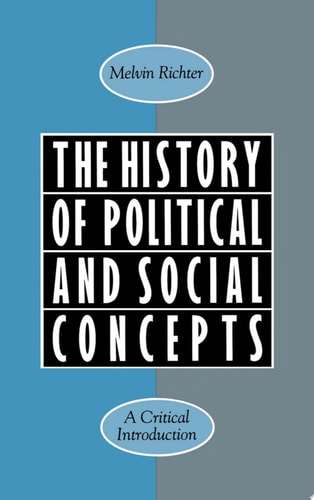
The History of Political and Social Concepts: A Critical Introduction
0
0
As an Amazon Associate and affiliate partner, Menrva Books earns from qualifying purchases. Learn more
Author Description
Since the 1960s, German scholars have developed distinctive methods for writing the history of political, social, and philosophical concepts. Applied to France as well as Germany, their work has set new standards for the historical study of political and social language, Begriffsgeschichte. The questions these scholars address, and the methods they apply systematically to a broad range of sources, differ as much from the styles of Hegel, Dilthey, and Meinecke as from those of A.O. Lovejoy, J.G.A. Pocock, and Quentin Skinner.Begriffsgeschichte treats political language neither as autonomous discourse, nor as the product of ideology, social structure, or elite manipulation. Although conceptual historians agree that the field of action is defined by language, they place concept formation and use within historical contexts. By surveying political and social discourses systematically, this genre traces how the great modern revolutions have been conceptualized in sharply contested forms by competing political and social formations, as well as by individual thinkers. Combining intellectual with social history, historians of concepts track linguistically the advent, mentalities, and effects of modernity.In The History of Political and Social Concepts, Melvin Richter analyzes the theories which have generated conceptual history, and their reinterpretation of key concepts such as Max Weber's three types of legitimate Herrschaft, and that of civilitÖè in France. What is it that we know when we learn the history of a concept? What difference does it make that we know it? After assessing the programs and achievements of Begriffsgeschichte, the author argues the need for an analogous project to chart the careers of political and social concepts used in English-speaking societies. Addressed not only to historians of political and social thought, this work will interest students and scholars of political culture, social historians, and historians of ideas, historiography, law, lang
Menrva's Summary
THE THESIS
This work investigates the methodological foundations and historical applications of Begriffsgeschichte, the German tradition of conceptual history, to determine its utility for English-speaking scholarship. Melvin Richter, a scholar of political theory and intellectual history, evaluates how this discipline moves beyond traditional history of ideas by situating concept formation within specific social and political contexts. He argues that by systematically analyzing the evolution of political language, historians can better understand the mentalities and structural shifts that define modernity. The text serves as both an introduction to existing German methodologies and a proposal for their adaptation in broader historical research.
THE SCOPE MAP
What You Will Find
- An analysis of the Begriffsgeschichte methodology compared to the approaches of Hegel, Dilthey, and Quentin Skinner.
- Case studies examining the evolution of specific concepts such as Max Weber’s types of Herrschaft and the French concept of civilité.
- A critical assessment of how conceptual history integrates intellectual and social history to track the effects of modern revolutions.
- A proposed framework for applying conceptual history to the political and social discourse of English-speaking societies.
THE AUTHORITY PERSPECTIVE
Scholars and historians frequently cite this text as a primary introduction to the German school of conceptual history for English-speaking audiences. Experts note that the prose is dense and academic, making it a foundational resource for students of historiography and political theory.
Page Count:
224
Publication Date:
1995-09-07
Publisher:
Oxford University Press
ISBN-10:
0195088263
ISBN-13:
9780195088267
Philosophy
History
Sociology - History
Historiography
Social Science
Community Tags
Similar Books