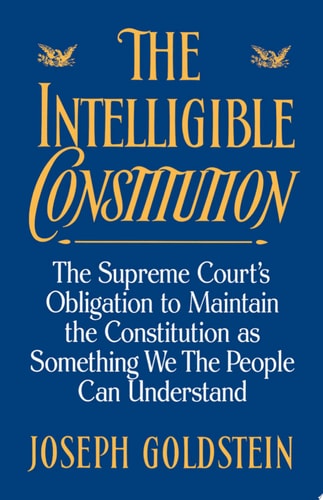
The Intelligible Constitution: The Supreme Court's Obligation to Maintain the Constitution as Something We the People Can Understand
0
0
As an Amazon Associate and affiliate partner, Menrva Books earns from qualifying purchases. Learn more
Author Description
In Webster v. Reproductive Health Services, a critical abortion rights case, a bitterly divided Supreme Court produced no less than six different opinions. Writing for the plurality, Chief Justice Rehnquist attacked the trimester framework established in Roe v. Wade because it was "not found in the text of the Constitution or in any place else one would expect to find a constitutional principle." This approach, writes legal authority Joseph Goldstein, confuses constitutional principles (in this case, the right to privacy) with the means to protect them (here, the trimester system). As a result, the Court left the public bewildered about the constitutional scope of a woman's right to reproductive choice--failing in its duty to speak clearly to the American public about the Constitution.In The Intelligible Constitution, Goldstein makes a compelling argument that, in a democracy based upon informed consent, the Supreme Court has an obligation to communicate clearly and candidly to We the People when it interprets the Constitution. After a fascinating discussion of the language of the Constitution and Supreme Court opinions (including the analysis of Webster), he presents a series of opinion studies in important cases, focusing not on ideology but on the Justices' clarity of thought and expression. Using the two Brown v. Board of Education cases, Cooper v. Aaron, Regents of the University of California v. Bakke, and others as his examples, Goldstein demonstrates the pitfalls to which the Court has succumbed in the past: Writing deliberately ambiguous decisions to win the votes of colleagues, challenging each others' opinions in private but not in public, and not speaking honestly when the writer knows a concurring Justice misunderstands the opinion which he or she is supporting. Even some landmark decisions, he writes, have featured seriously flawed opinions--preventing We the People from understanding why the Justices reasoned as they did, and why they disagreed with each other.
Menrva's Summary
THE THESIS
The core question investigated is whether the Supreme Court possesses an inherent obligation to communicate its constitutional interpretations in a clear, intelligible manner to the American public. Joseph Goldstein, a legal scholar, argues that in a democracy predicated on informed consent, the Court fails its duty when it produces ambiguous or fractured opinions. He posits that the Court often prioritizes internal consensus or political maneuvering over the necessity of providing a coherent, understandable rationale for its decisions to the citizenry.
THE SCOPE MAP
What You Will Find
- Analysis of the linguistic clarity of landmark Supreme Court opinions.
- Case studies including Brown v. Board of Education, Cooper v. Aaron, and Regents of the University of California v. Bakke.
- Examination of the internal dynamics of the Court, such as the practice of writing ambiguous decisions to secure colleague votes.
- A critique of how judicial obfuscation undermines the democratic principle of informed consent.
THE AUTHORITY PERSPECTIVE
Legal scholars and political scientists frequently cite this work for its focus on the intersection of judicial rhetoric and democratic accountability. Readers often note the accessible yet rigorous nature of the prose, which provides a critical lens through which to evaluate the transparency of the highest court in the United States.
Page Count:
224
Publication Date:
1995-08-24
Publisher:
Oxford University Press
ISBN-10:
0195093755
ISBN-13:
9780195093759
Supreme Court
Law
Constitutional Law
United States
Government
Community Tags
Other Editions(2)
Similar Books









Reader Comments
Share Your Thoughts
No comments yet. Be the first to share your thoughts!