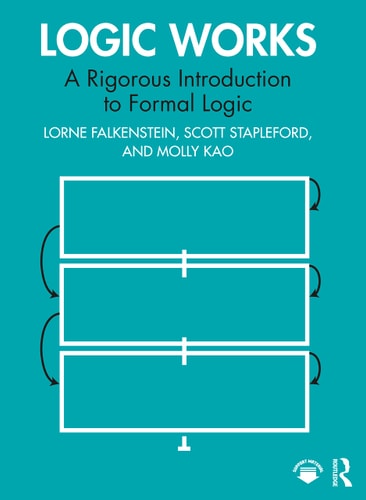
Logic Works: A Rigorous Introduction to Formal Logic
0
0
As an Amazon Associate and affiliate partner, Menrva Books earns from qualifying purchases. Learn more
Author Description
Logic Works is a critical and extensive introduction to logic. It asks questions about why systems of logic are as they are, how they relate to ordinary language and ordinary reasoning, and what alternatives there might be to classical logical doctrines. The book covers classical first-order logic and alternatives, including intuitionistic, free, and many-valued logic. It also considers how logical analysis can be applied to carefully represent the reasoning employed in academic and scientific work, better understand that reasoning, and identify its hidden premises. Aiming to be as much a reference work and handbook for further, independent study as a course text, it covers more material than is typically covered in an introductory course. It also covers this material at greater length and in more depth with the purpose of making it accessible to those with no prior training in logic or formal systems. Online support material includes a detailed student solutions manual with a running commentary on all starred exercises, and a set of editable slide presentations for course lectures. Key Features Introduces an unusually broad range of topics, allowing instructors to craft courses to meet a range of various objectives Adopts a critical attitude to certain classical doctrines, exposing students to alternative ways to answer philosophical questions about logic Carefully considers the ways natural language both resists and lends itself to formalization Makes objectual semantics for quantified logic easy, with an incremental, rule-governed approach assisted by numerous simple exercises Makes important metatheoretical results accessible to introductory students through a discursive presentation of those results and by using simple case studies
Menrva's Summary
THE THESIS
This book investigates the fundamental nature and structure of logical systems, questioning their inherent design and exploring their relationship with everyday reasoning. It delves into classical first-order logic and its alternatives, such as intuitionistic, free, and many-valued logics, examining how these formal systems can be applied to represent and understand academic and scientific reasoning. The authors aim to provide a comprehensive resource that goes beyond typical introductory material, offering depth and accessibility for those new to formal logic, while also serving as a handbook for advanced study.
THE SCOPE MAP
- Exploration of classical first-order logic and its foundational principles.
- Introduction to alternative logical systems including intuitionistic, free, and many-valued logics.
- Analysis of the relationship between formal logic and natural language.
- Application of logical analysis to represent and understand academic and scientific reasoning.
- Detailed coverage of objectual semantics for quantified logic with an incremental approach.
- Presentation of key metatheoretical results using simple case studies.
- Inclusion of more material than typically found in introductory courses, presented in greater length and depth.
- Online support materials including a student solutions manual and lecture slide presentations.
THE AUTHORITY PERSPECTIVE
This text is designed as a rigorous and comprehensive introduction to logic, intended for both course use and independent study. Its broad scope and critical examination of classical doctrines, alongside accessible explanations of complex metatheoretical results, suggest it is aimed at students seeking a deep understanding of formal systems. The inclusion of extensive online support materials further indicates a commitment to pedagogical effectiveness and accessibility for learners with no prior formal training.
Page Count:
646
Publication Date:
2021-11-30
Publisher:
Routledge
ISBN-10:
0367460297
ISBN-13:
9780367460297
Philosophy
Science & Technology
Non-Fiction
Formal Logic
Community Tags
Other Editions(4)

Similar Books



Reader Comments
Share Your Thoughts
No comments yet. Be the first to share your thoughts!