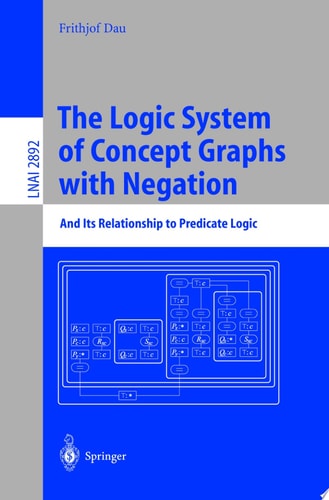
The Logic System of Concept Graphs with Negation And Its Relationship to Predicate Logic
0
0
As an Amazon Associate and affiliate partner, Menrva Books earns from qualifying purchases. Learn more
Author Description
The aim of contextual logic is to provide a formal theory of elementary logic, which is based on the doctrines of concepts, judgements, and conclusions. Concepts are mathematized using Formal Concept Analysis (FCA), while an approach to the formalization of judgements and conclusions is conceptual graphs, based on Peirce's existential graphs. Combining FCA and a mathematization of conceptual graphs yields so-called concept graphs, which offer a formal and diagrammatic theory of elementary logic. Expressing negation in contextual logic is a difficult task. Based on the author's dissertation, this book shows how negation on the level of judgements can be implemented. To do so, cuts (syntactical devices used to express negation) are added to concept graphs. As we can express relations between objects, conjunction and negation in judgements, and existential quantification, the author demonstrates that concept graphs with cuts have the expressive power of first-order predicate logic. While doing so, the author distinguishes between syntax and semantics, and provides a sound and complete calculus for concept graphs with cuts. The author's treatment is mathematically thorough and consistent, and the book gives the necessary background on existential and conceptual graphs.
Menrva's Summary
THE THESIS
This book investigates the formal theory of elementary logic by mathematizing concepts, judgments, and conclusions through the integration of Formal Concept Analysis (FCA) and conceptual graphs. The author, Frithjof Dau, builds upon his dissertation to present a formal and diagrammatic theory of elementary logic, known as concept graphs. The core challenge addressed is the implementation of negation within this framework, achieved by introducing 'cuts' to concept graphs. Dau demonstrates that concept graphs with these cuts possess the expressive power equivalent to first-order predicate logic, covering relations, conjunction, negation, and existential quantification.
THE SCOPE MAP
- Formalization of concepts using Formal Concept Analysis (FCA).
- Conceptual graphs as a formalization of judgments and conclusions, based on Peirce's existential graphs.
- Integration of FCA and conceptual graphs to form 'concept graphs'.
- Introduction of 'cuts' as syntactical devices to implement negation on the level of judgments.
- Demonstration of concept graphs with cuts having the expressive power of first-order predicate logic.
- Distinction between syntax and semantics in the treatment of concept graphs.
- Presentation of a sound and complete calculus for concept graphs with cuts.
- Inclusion of necessary background on existential and conceptual graphs.
THE AUTHORITY PERSPECTIVE
The book presents a mathematically thorough and consistent treatment of concept graphs with negation, building upon established logical frameworks. Its approach integrates Formal Concept Analysis with conceptual graphs to offer a formal and diagrammatic theory of elementary logic. The work is noted for its rigorous exploration of how negation can be implemented within this system, ultimately demonstrating its equivalence to first-order predicate logic. The author provides essential background material, making the complex subject accessible to those with a foundational understanding of logic.
Page Count:
213
Publication Date:
2003-11-24
Publisher:
Springer Science & Business Media
ISBN-10:
3540206078
ISBN-13:
9783540206071
Non-Fiction
Science
Philosophy
Mathematics
Computer Science
Formal Logic
Logic
Community Tags
Similar Books