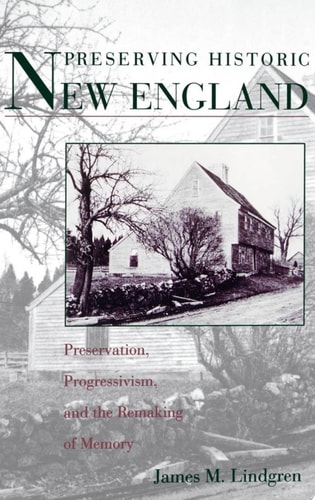
Preserving Historic New England: Preservation, Progressivism, and the Remaking of Memory
0
0
As an Amazon Associate and affiliate partner, Menrva Books earns from qualifying purchases. Learn more
Author Description
By the first years of the twentieth century the memory of old-time New England was in danger. What had once been a land of small towns populated by tradition-minded Yankees was now becoming almost unrecognizable with a floodtide of immigrants and the constant change of a modernizing society. At the same time, cities such as Boston, Portsmouth, and Salem were bursting at the seams with factories, high-rises, and uncontrollable growth. During a period when the Colonial Revival and progressive movements held sway, Yankees asserted their influence through campaigns to redefine the meaning of their Anglo-American forebears. As part of the reaction, the modern preservation movement was founded by William Sumner Appleton, Jr., a privileged, old-blooded Bostonian. Resisting not simply this avalanche of change but the amateurish romanticism of fellow antiquaries, Appleton founded the Society for the Preservation of New England Antiquities in 1910. While examining SPNEA in the context of progressivism, Preserving Historic New England focuses on its redefinition of preservation to fit the methodology of science, the economy of capitalism, and the aestheticism of architecture. In so doing, preservation not only became a profession defined by those male worlds, but remade Yankee memory to accord with the modern corporate order.
Menrva's Summary
THE THESIS
This work investigates how the early twentieth-century historic preservation movement in New England functioned as a mechanism for social and cultural control during a period of rapid modernization. James M. Lindgren, a historian specializing in American cultural heritage, utilizes the archives of the Society for the Preservation of New England Antiquities (SPNEA) to analyze the intersection of preservation, progressivism, and identity. He argues that the movement, led by figures like William Sumner Appleton, Jr., professionalized the act of memory-making to align historical narratives with the values of the corporate and capitalist order of the time.
THE SCOPE MAP
What You Will Find
- Analysis of the transition from amateur antiquarianism to professionalized historic preservation.
- Examination of the Colonial Revival movement as a response to immigration and industrialization.
- Case studies of preservation efforts in Boston, Portsmouth, and Salem.
- Exploration of how architectural aesthetics were used to codify Anglo-American identity.
THE AUTHORITY PERSPECTIVE
Scholars recognize this text as a significant contribution to the study of American cultural history and the institutionalization of heritage. Readers frequently note the academic rigor of the research and the author's ability to connect architectural preservation to broader socio-political shifts in the early twentieth century.
Page Count:
256
Publication Date:
1995-11-09
Publisher:
Oxford University Press
ISBN-10:
0195093631
ISBN-13:
9780195093636
History
Architecture
Historic Preservation
New England
Sociology
urban planning