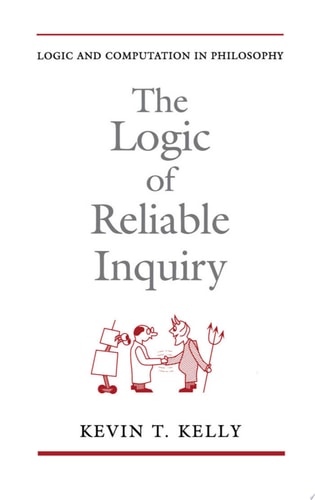
The Logic of Reliable Inquiry
0
0
As an Amazon Associate and affiliate partner, Menrva Books earns from qualifying purchases. Learn more
Author Description
There are many proposed aims for scientific inquiry--to explain or predict events, to confirm or falsify hypotheses, or to find hypotheses that cohere with our other beliefs in some logical or probabilistic sense. This book is devoted to a different proposal--that the logical structure of the scientist's method should guarantee eventual arrival at the truth given the scientist's background assumptions. Interest in this methodological property, called "logical reliability," stems from formal learning theory, which draws its insights not from the theory of probability, but from the theory of computability. Kelly first offers an accessible explanation of formal learning theory, then goes on to develop and explore a systematic framework in which various standard learning theoretic results can be seen as special cases of simpler and more general considerations. This approach answers such important questions as whether there are computable methods more reliable than Bayesian updating or Popper's method of conjectures and refutations. Finally, Kelly clarifies the relationship between the resulting framework and other standard issues in the philosophy of science, such as probability, causation, and relativism. His work is a major contribution to the literature and will be essential reading for scientists, logicians, and philosophers
Menrva's Summary
THE THESIS
This book investigates whether the logical structure of scientific methodology can guarantee the eventual discovery of truth based on specific background assumptions. Kevin T. Kelly, a scholar in formal learning theory, utilizes the theory of computability rather than traditional probability to evaluate scientific inquiry. He constructs a systematic framework to determine if computable methods can outperform established approaches like Bayesian updating or Popperian falsification. By bridging formal logic and the philosophy of science, the text provides a rigorous analysis of how methods converge toward truth.
THE SCOPE MAP
What You Will Find
- Formal learning theory principles derived from computability theory
- Comparative analysis of Bayesian updating versus Popperian methods
- A systematic framework for evaluating the reliability of scientific inquiry
- Philosophical implications regarding causation, probability, and relativism
THE AUTHORITY PERSPECTIVE
Experts recognize this work as a significant contribution to the intersection of formal logic and the philosophy of science. Readers frequently note the technical density of the prose, which is intended for an audience of logicians, scientists, and philosophers.
Page Count:
448
Publication Date:
1996-01-04
Publisher:
Oxford University Press
ISBN-10:
0195091957
ISBN-13:
9780195091953
Philosophy
Science
Epistemology
Logic
Community Tags
Other Editions(3)
Similar Books