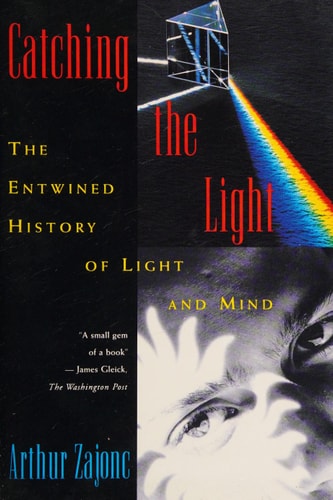
Catching the Light: The Entwined History of Light and Mind
0
0
As an Amazon Associate and affiliate partner, Menrva Books earns from qualifying purchases. Learn more
Author Description
In 1910, the surgeons Moreau and LePrince wrote about their successful operation on an eight-year-old boy who had been blind since birth because of cataracts. When the boy's eyes were healed they removed the bandages and, waving a hand in front of the child's physically perfect eyes, asked him what he saw. "I don't know," was his only reply. What he saw was only a varying brightness in front of him. However, when allowed to touch the hand as it began to move, he cried out in a voice of triumph, "It's moving!" He could feel it move, but he still needed laboriously to learn to see it move. Light and eyes were not enough to grant him sight. How, then, do we see? What's the difference between seeing and perception? What is light?From ancient times to the present, from philosophers to quantum physicists, nothing has so perplexed, so fascinated, so captivated the mind as the elusive definition of light. In Catching the Light, Arthur Zajonc takes us on an epic journey into history, tracing how humans have endeavored to understand the phenomenon of light. Blending mythology, religion, science, literature, and painting, Zajonc reveals in poetic detail the human struggle to identify the vital connection between the outer light of nature and the inner light of the human spirit. He explains the curiousness of the Greeks' blue and green "color blindness": Odysseus gazing longingly at the "wine-dark sea"; the use of chloros (green) as the color of honey in Homer's Odessey; and Euripides' use of the color green to describe the hue of tears and blood. He demonstrates the complexity of perception through the work of Paul Cézanne--the artist standing on the bank of a river, painting the same scene over and over again, the motifs multiplying before his eyes. And Zajonc goes on to show how our quest for an understanding of light, as well as the conclusions we draw, reveals as much about the nature of our own psyche as it does about the nature of light itself. For the ancient Egyptians
Menrva's Summary
THE THESIS
This book investigates the fundamental question of how human perception interacts with the physical nature of light, bridging the gap between objective scientific phenomena and subjective human experience. Arthur Zajonc, a physicist and scholar, utilizes a multidisciplinary approach that synthesizes historical accounts, philosophical inquiry, and scientific data. He argues that the human understanding of light is not merely a record of physical discovery, but a reflection of the evolving human psyche and its internal capacity for vision.
THE SCOPE MAP
What You Will Find
- Historical analysis of light theories from ancient Egyptian, Greek, and Homeric perspectives.
- Examination of the intersection between quantum physics and human consciousness.
- Case studies on the development of visual perception, including historical medical accounts of restored sight.
- Exploration of artistic representations of light, specifically through the works of Paul Cézanne.
THE AUTHORITY PERSPECTIVE
Experts and readers frequently note the book's unique ability to synthesize rigorous physics with humanities-based inquiry. It is often cited as a foundational text for those interested in the philosophical implications of optics and the history of human perception.
Page Count:
400
Publication Date:
1995-04-20
Publisher:
Oxford University Press
ISBN-10:
0195095758
ISBN-13:
9780195095753
Philosophy
Psychology
Science
Physics
Light
Art History
Community Tags
Similar Books