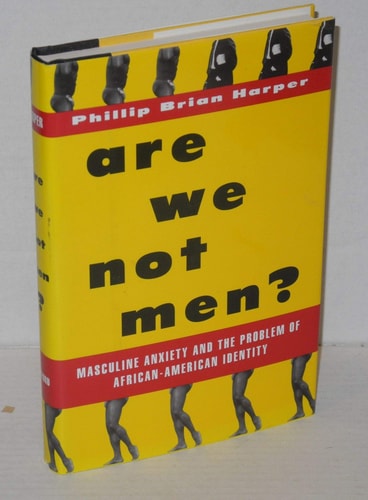
Are We Not Men?: Masculine Anxiety and the Problem of African-American Identity
0
0
As an Amazon Associate and affiliate partner, Menrva Books earns from qualifying purchases. Learn more
Author Description
In 1995, popular anxieties about black masculinity became evident in public reactions to the conclusion of the OJ Simpson trial and the Million Man March on Washington. The nation's divided response to the OJ verdict, together with the controversy surrounding Louis Farrakhan's call to black men to come together for a "day of atonement" brought issues of race and gender to the forefront of national debate.In his timely and incisive book Are We Not Men?, Phillip Brian Harper explores issues of race and representation and shows that ideas about black masculinity have always played a troubled role both in the formation of African-American identity and in the mass media at large. What is at stake when a picture of OJ Simpson is darkened on the cover of Time magazine? Why is AIDS still seen as a white gay disease when a quarter of deaths from AIDS from 1981-1991 were among black males? Using examples from a variety of cultural contexts, ranging from sports and pop music to literature and television, Harper investigates these questions in an effort to show the ways in which narrow definitions of black manhood have failed to acknowledge real differences within the African-American community--to grave social and political effect. He examines recent phenomena, such as reactions to ABC anchorman Max Robinson's AIDS-related death and Magic Johnson's HIV status, as well as the homophobia and chauvinism of the Black Arts movement of the '60s and '70s, the construction of black "crossover" identity from Motown and Diana Ross to Run-DMC and MTV and the way that "street" authenticity is incorporated into Michael Jackson's choreography. He unravels the gender politics behind the "passing" novels of the Harlem Renaissance, scrutinizes black masculinity as seen through the eyes of the white protagonist of the 1961 autobiographical narrative Black Like Me and explores early representations of African Americans on television shows like "Julia" and "Room 222."
Menrva's Summary
THE THESIS
This book investigates how narrow, restrictive definitions of black masculinity have historically shaped African-American identity and influenced broader American cultural and political discourse. Phillip Brian Harper, a scholar of literature and cultural studies, utilizes a multidisciplinary framework to analyze how race and gender intersect within the public imagination. By examining media representations, literary texts, and political events, he argues that these rigid constructions of manhood often obscure the internal diversity of the African-American community and perpetuate harmful social consequences.
THE SCOPE MAP
What You Will Find
- Analysis of media representations including the OJ Simpson trial, Time magazine covers, and television programs like Julia and Room 222.
- Examination of the gender politics within the Black Arts movement and the Harlem Renaissance.
- Case studies on the public perception of HIV/AIDS in relation to figures like Magic Johnson and Max Robinson.
- Exploration of the construction of black crossover identity in music, from Motown to MTV.
THE AUTHORITY PERSPECTIVE
Scholars and critics frequently cite this work as a foundational text for understanding the intersection of race, gender, and media representation in the late 20th century. Readers often note the academic density of the prose, which provides a rigorous examination of cultural phenomena through a critical theory lens.
Page Count:
272
Publication Date:
1996-09-19
Publisher:
Oxford University Press
ISBN-10:
0195092740
ISBN-13:
9780195092745
History
Men
Media Studies
Sociology
Gender Studies
African Americans
Community Tags
Similar Books














