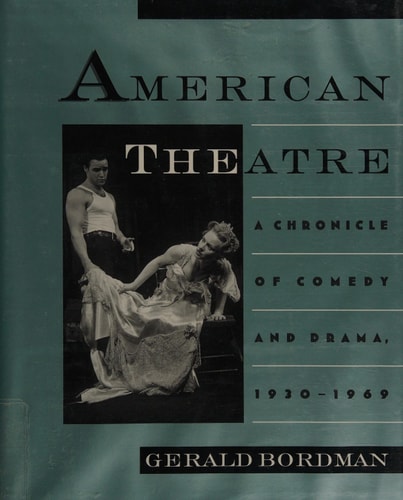
American Theatre: A Chronicle of Comedy and Drama, 1930-1969
0
0
As an Amazon Associate and affiliate partner, Menrva Books earns from qualifying purchases. Learn more
Author Description
This book concludes Gerald Bordman's acclaimed survey of American non-musical theatre. It deals with the years 1930 to 1970, a period when the number of yearly new plays was shrinking, but a period during which American drama as a whole entered the world stage and became a dominant force. With works like Eugene O'Neill's Long Day's Journey Into Night, Tennessee William's A Streetcar Named Desire, and Arthur Miller's Death of a Salesman, American theater finally reached adulthood both dramatically and psychologically. Bordman's lively, authoritative study covers every Broadway production, as well as every major off-Broadway show. His discussion moves season by season and show by show in chronological order; he offers plot synopses and details the physical production, directors, players, theaters, and newspaper reviews. This book and the preceding volumes of American Theatre stand as the premier history of American drama.
Menrva's Summary
THE THESIS
This volume investigates the evolution of American non-musical theatre during the transformative decades between 1930 and 1969. Gerald Bordman, a respected historian of the American stage, utilizes a chronological framework to document the maturation of domestic drama. By analyzing the shift from high-volume production to the emergence of globally significant works, the author argues that this era represents the psychological and dramatic coming-of-age for the American theatre industry.
THE SCOPE MAP
What You Will Find
- Comprehensive coverage of every Broadway production and major off-Broadway show from 1930 to 1969.
- Detailed production data including directors, cast members, and specific venue information.
- Synopses of major plays by seminal figures such as Eugene O'Neill, Tennessee Williams, and Arthur Miller.
- Analysis of contemporary critical reception through the lens of period newspaper reviews.
THE AUTHORITY PERSPECTIVE
Experts and theater historians frequently cite this work as a foundational reference for the study of mid-twentieth-century American drama. Readers note the high density of factual information and the systematic, season-by-season approach that makes it an essential resource for academic research.
Page Count:
480
Publication Date:
1996-11-21
Publisher:
Oxford University Press
ISBN-10:
0195090799
ISBN-13:
9780195090796
Drama
Non-Fiction
History
Theater
United States