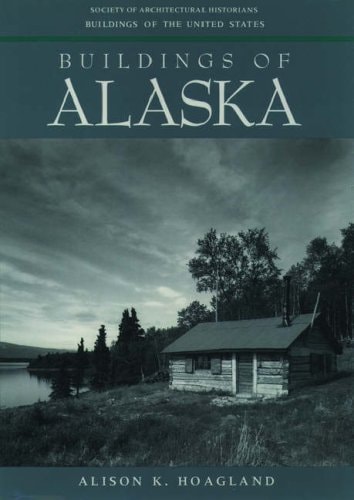
Buildings of Alaska
0
0
As an Amazon Associate and affiliate partner, Menrva Books earns from qualifying purchases. Learn more
Author Description
Buildings of Alaska traces Alaska's architecture from the earliest dwellings made of sod, whalebone, and driftwood to the glass and metal skyscrapers of modern-day Anchorage. Focusing on the various cultural traditions that have helped shape the state's architecture, the volume also explores how Alaska's buildings reflect Alaskan's attempt to adapt to the unique conditions of their environment.Here, Alison K. Hoagland examimes the contribution to the state's architectural history of three major cultural groups: native Alaskans, Russian settlers, and Americans for the lower 48. Divided into six regions--South Central, Southeastern, Interior, Northern, Western, and Southwestern--entries cover such structures as aboriginal houses, Russian Orthodix chruches, log roadhouses, false-front commercial buildings constructed during the gold-rush, concrete Moderne public buildings of the 1930s, and high-rise office buildings erected during the oil boom of the 1970s and 1980s.With over 250 photgraphs, drawings, and maps, Buildings of Alaska is an unprecedented look at how Alaska's buildings reveal the personal attitudes and cultural precepts of its diverse group of inhabitants.
Menrva's Summary
THE THESIS
This volume investigates how Alaska's architectural landscape serves as a physical record of the state's diverse cultural history and its ongoing adaptation to a challenging subarctic environment. Alison K. Hoagland, an expert in architectural history, synthesizes historical data and site analysis to argue that the built environment of Alaska is a direct reflection of the competing and overlapping influences of Native Alaskans, Russian settlers, and American migrants. The book utilizes a regional framework to categorize these developments, providing a comprehensive overview of how human necessity and cultural identity have shaped the construction of the state over several centuries.
THE SCOPE MAP
What You Will Find
- A regional analysis covering South Central, Southeastern, Interior, Northern, Western, and Southwestern Alaska.
- Documentation of diverse building types ranging from indigenous sod and whalebone dwellings to 20th-century oil-boom skyscrapers.
- Primary source evidence including over 250 photographs, architectural drawings, and detailed maps.
- A thematic exploration of how Russian Orthodox, gold-rush commercial, and Moderne public architecture define the state's historical trajectory.
THE AUTHORITY PERSPECTIVE
Experts and architectural historians recognize this work as a foundational reference for understanding the intersection of geography and construction in the American North. Readers frequently note the academic density of the prose and the extensive visual documentation provided, which makes it an essential resource for scholars of regional history.
Page Count:
352
Publication Date:
1995-02-09
Publisher:
Oxford University Press
ISBN-10:
0195093801
ISBN-13:
9780195093803
Architecture
History
Architecture
United States
Alaska
Regional History