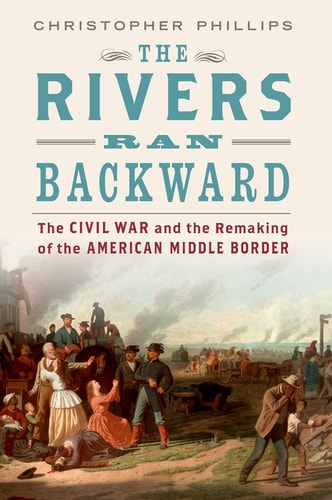
The Rivers Ran Backward: The Civil War and the Remaking of the American Middle Border
0
0
As an Amazon Associate and affiliate partner, Menrva Books earns from qualifying purchases. Learn more
Author Description
Most Americans imagine the Civil War in terms of clear and defined boundaries of freedom and slavery: a straightforward division between the slave states of Kentucky and Missouri and the free states of Illinois, Indiana, Ohio, and Kansas. However, residents of these western border states, Abraham Lincoln's home region, had far more ambiguous identities-and contested political loyalties-than we commonly assume.In The Rivers Ran Backward, Christopher Phillips sheds light on the fluid political cultures of the "Middle Border" states during the Civil War era. Far from forming a fixed and static boundary between the North and South, the border states experienced fierce internal conflicts over their political and social loyalties. White supremacy and widespread support for the existence of slavery pervaded the "free" states of Ohio, Indiana, and Illinois, which had much closer economic and cultural ties to the South, while those in Kentucky and Missouri held little identification with the South except over slavery. Debates raged at every level, from the individual to the state, in parlors, churches, schools, and public meeting places, among families, neighbors, and friends. Ultimately, the pervasive violence of the Civil War and the cultural politics that raged in its aftermath proved to be the strongest determining factor in shaping these states' regional identities, leaving an indelible imprint on the way in which Americans think of themselves and others in the nation.The Rivers Ran Backward reveals the complex history of the western border states as they struggled with questions of nationalism, racial politics, secession, neutrality, loyalty, and even place-as the Civil War tore the nation, and themselves, apart. In this major work, Phillips shows that the Civil War was more than a conflict pitting the North against the South, but one within the West that permanently reshaped American regions.
Menrva's Summary
THE THESIS
This work investigates how the Civil War fundamentally reshaped the regional identities of the American Middle Border states, challenging the traditional binary of North versus South. Christopher Phillips, a historian specializing in the American West and the Civil War era, utilizes a vast array of primary sources—including personal correspondence, local newspapers, and political records—to reconstruct the fractured loyalties of residents in Kentucky, Missouri, Illinois, Indiana, and Ohio. He argues that these states functioned as a fluid, contested zone where racial politics, economic ties, and shifting national allegiances created a unique internal conflict that persisted long after the cessation of hostilities.
THE SCOPE MAP
What You Will Find
- Analysis of political and social discourse within the Middle Border states during the 1860s.
- Examination of the economic and cultural interdependencies between free and slave states in the region.
- Detailed accounts of internal debates regarding secession, neutrality, and white supremacy.
- Investigation into how wartime violence altered the long-term regional identity of the American West.
Scope Limits
- The study focuses primarily on the Middle Border region and does not provide a comprehensive military history of the broader Civil War.
- It does not extensively cover the political developments of the Deep South or the Northeast.
THE AUTHORITY PERSPECTIVE
Historians and scholars of the Civil War era frequently cite this work for its nuanced approach to regional identity and its rejection of simplistic North-South dichotomies. Readers often note the academic density of the prose, which provides a rigorous examination of the complex political landscape of the nineteenth-century American West.
Page Count:
528
Publication Date:
2019-05-01
Publisher:
Oxford University Press
ISBN-10:
0190053801
ISBN-13:
9780190053802
History
Americas
Social History
Political History
Regional History
Middle West
United States
American History
Civil War
New Used & Rental Textbooks
Group Identity
Regionalism
Community Tags
Similar Books