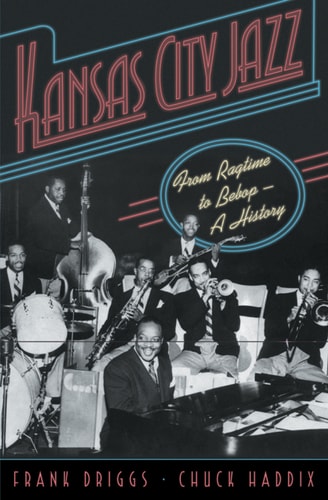
Kansas City Jazz: From Ragtime to Bebop--A History
0
0
As an Amazon Associate and affiliate partner, Menrva Books earns from qualifying purchases. Learn more
Author Description
There were but four major galaxies in the early jazz universe, and three of them--New Orleans, Chicago, and New York--have been well documented in print. But there has never been a serious history of the fourth, Kansas City, until now. In this colorful history, Frank Driggs and Chuck Haddix range from ragtime to bebop and from Bennie Moten to Charlie Parker to capture the golden age of Kansas City jazz. Readers will find a colorful portrait of old Kaycee itself, back then a neon riot of bars, gambling dens and taxi dance halls, all ruled over by Boss Tom Pendergast, who had transformed a dusty cowtown into the Paris of the Plains. We see how this wide-open, gin-soaked town gave birth to a music that was more basic and more viscerally exciting than other styles of jazz, its singers belting out a rough-and-tumble urban style of blues, its piano players pounding out a style later known as "boogie-woogie." We visit the great landmarks, like the Reno Club, the "Biggest Little Club in the World," where Lester Young and Count Basie made jazz history, and Charlie Parker began his musical education in the alley out back. And of course the authors illuminate the lives of the great musicians who made Kansas City swing, with colorful profiles of jazz figures such as Mary Lou Williams, Big Joe Turner, Jimmy Rushing, and Andy Kirk and his "Clouds of Joy." Here is the definitive account of the raw, hard-driving style that put Kansas City on the musical map. It is a must read for everyone who loves jazz or American music history.
Menrva's Summary
THE THESIS
This book investigates the development and cultural significance of the Kansas City jazz scene, positioning it as a foundational pillar of American music history alongside New Orleans, Chicago, and New York. Authors Chuck Haddix and Frank Driggs utilize extensive historical research and archival documentation to trace the evolution of the genre from ragtime to bebop. They argue that the unique political and social climate of Kansas City under Boss Tom Pendergast created a distinct, visceral musical style that defined the era.
THE SCOPE MAP
What You Will Find
- Historical analysis of the Kansas City jazz scene from the ragtime era through the emergence of bebop.
- Profiles of influential musicians including Charlie Parker, Count Basie, Mary Lou Williams, and Big Joe Turner.
- Documentation of key performance venues such as the Reno Club.
- Contextual history of the Pendergast political machine and its impact on the city's nightlife.
Scope Limits
- The text focuses primarily on the Kansas City scene and does not provide a comprehensive history of jazz in other major cities.
- The narrative concludes with the transition into the bebop era and does not cover later developments in jazz history.
THE AUTHORITY PERSPECTIVE
Experts and music historians recognize this work as a foundational text that fills a significant gap in the documentation of American jazz history. Readers frequently note the depth of the research and the vivid, atmospheric prose used to describe the social environment of the period.
Page Count:
314
Publication Date:
2005-01-01
Publisher:
Oxford University Press
ISBN-10:
0190281456
ISBN-13:
9780190281458
History
Biography
Jazz
American History
Music History
Regional History
Humanities
Community Tags
Similar Books